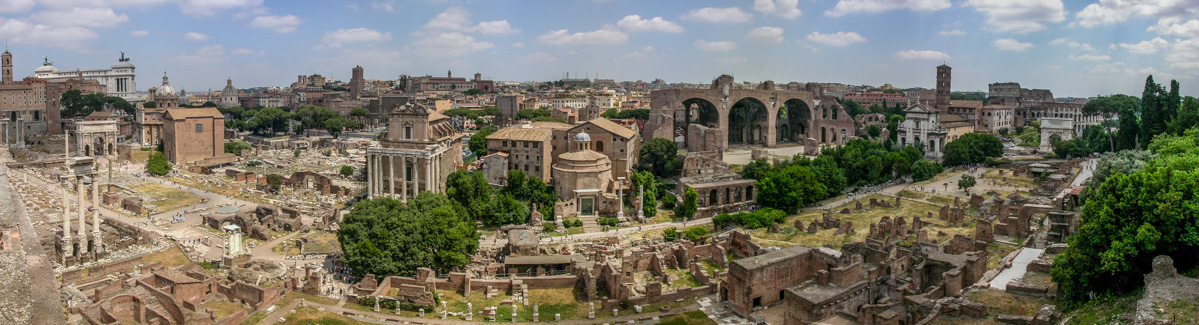
The Forum was the original downtown of Rome, a former swampland drained by the world's first great city sewer and then filled with temples, government buildings, markets, and the hubbub of the early Roman Republic.
The Forum today? Several cracked, fluted columns pick out the corner or side of some long-vanished temple.
Jumbled blocks of ancient marble lie in the dust and weeds.
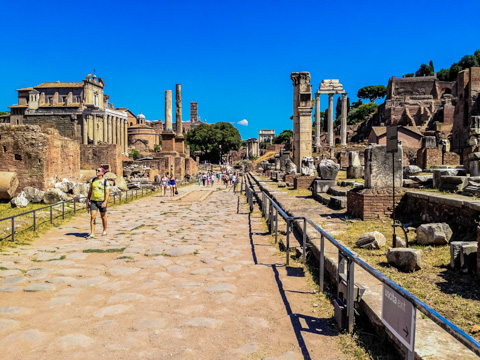
Your feet pound against the worn flagstones of Rome's original, 2,000-year-old roads.
The rostra atop which the great orators once harangued the crowds now stands empty.
Squat triumphal arches are set with crumbling carved reliefs. The airy Senate building survives intact.
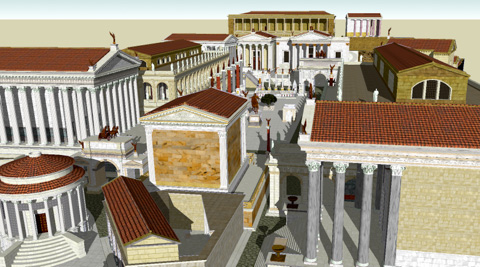
A set of steps ends at a platform where once stood a temple dedicated to the deified Julius Caesar.
The towering walls and apses that made up one-half of the original "basilica," the Roman law courts that later provided a blueprint for the first great churches.
Tourists pose atop the empty pedestals around the statue-lined pool of the House of the Vestal Virgins, near the cracked shell of a temple where they once kept the sacred fire burning.
There are standing ranks of columns here and there marking the sites of once-important temples and buildings. Much of it means little to those of us who aren't fresh from a class in ancient history, so I'll highlight a few of the more visually spectacular sights.
» Check out this slideshow of images of the Forum from throughout the ages.
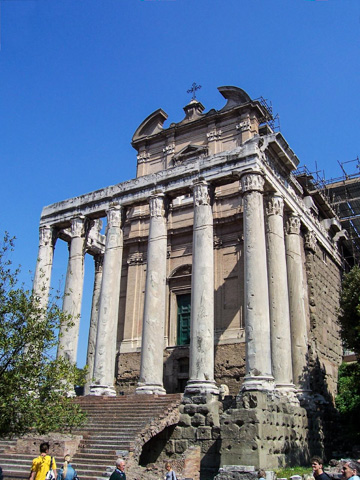
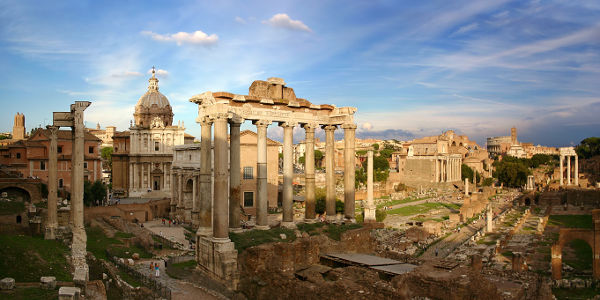
As you walk down the sloping entrance road, on your left is a medieval church grafted onto and above the Temple of Antonius & Faustina (pictured above), the eight columns still standing free of the church fabric at the top of some steps.
It was built in AD 141 by Antonius Pius in honor of his late wife, Faustina.
Turn right at the bottom of the entrance slope to walk west along the old Via Sacra, or "Holy Way" (the Main Street or High Street of Ancient Rome, down which triumphal military parades and imperial procession marched) toward that arch you see.
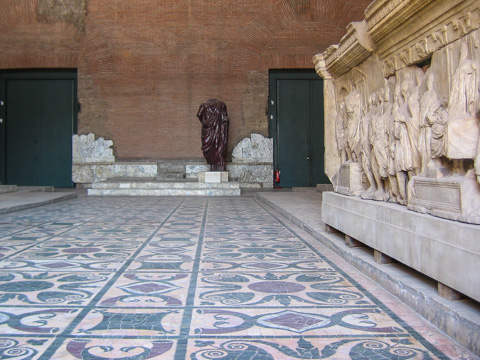
Just before the arch on your right is the large brick Curia Iulia built by Julius Caesar, the main seat of the Roman Senate and remarkably well preserved—especially for the Forum—partly thanks to its being transformed into a church in the Middle Ages.
If it's unlocked pop inside to see the flooring of opus sectile (marble inlay), an AD 3rd-century original, and some bits of marble friezes.
Across from it rises the exclamation mark of the Column of Phocas, a single column that stands as the latest "ancient" thing in the Froum, erected in AD 608.
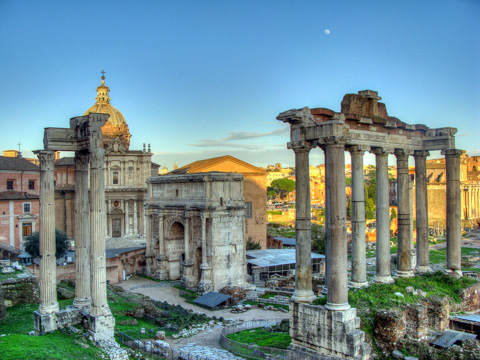
The triumphal Arch of Septimius Severus (AD 203) displays time-bitten reliefs of the emperor's victories in what are today Iran and Iraq.
This was one of the few bits of the Forum to remain above ground throughout the Middle Ages, and appears in many Romantic-era etchings and paintings of the overgrown, pre-excavation Forum.
Up against the south side ot the arch are the remains of a cylindrical lump of rock with some marble steps curving off it.
That round stone was the Umbilicus Urbus, considered the center of Rome and of the entire Roman empire, and the curving steps of the Imperial Rostra, where great orators and legislators stood to speak and the people gathered to listen.
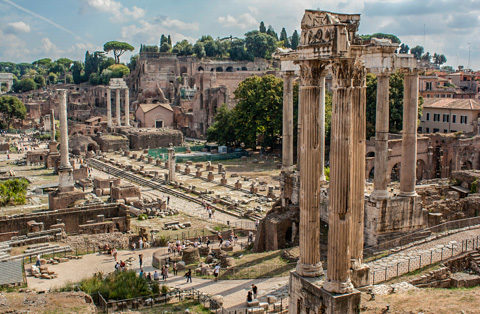
Anchoring the northwest end of the Forum is the Capitoline Hill—the modern buildings of which are raised upon a foundation comprised of the ancient Tabularium, where the ancients stored their State Archives.
See the tourists peeking out? They're scurrying down a tunnel borrowed from the Tabularium that now forms an interconnect between the two wings of the Capitoline Museums. Cool.
In front of you, at the base of this hill, is the much-photographed trio of fluted columns with Corinthian capitals supporting a bit of architrave to form the corner of the Temple of Vespasian and Titus.
Emperors were routinely turned into gods upon dying, and so it was with this first-ever (biological) father-son pair of Emperors, who established the Flavian dynasty, infamously put down the Jewish Rebellion (see the end of this page), and are probably most famous for starting (Vesapsian) and completing (Titus) the massive Flavian Amphitheater, known today by its later nickname, the Colosseum.
Start heading to your left toward the eight standing Ionic columns comprising the front and corners to the Temple of Saturn (rebuilt 42 BC), which housed the first treasury of Republican Rome.
Ho-Ho-Ho, Merry Saturnalia!
Faith aside, there's only a 1-in-365 chance that Jesus was actually born on December 25. Part of Christianity’s early success was its savvy leaders' ability to graft their new cult onto existing pagan ones, taking things like the popular holiday of Saturnalia and making it their own so as to render Christianity more familiar and palatable to potential converts.
It was also where they threw one of the Roman year's biggest annual blowout festivals, the December 17 feast of Saturnalia, which, after a bit of tweaking and the wandering of the calendar, we now celebrate as Christmas (see the box to the right).
Here you turn left to start heading back east, walking along the Forum's southern side, past the worn steps and stumps of brick pillars (19th-century reconstructions) that outline the enormous Basilica Julia, built by Julius Caesar.
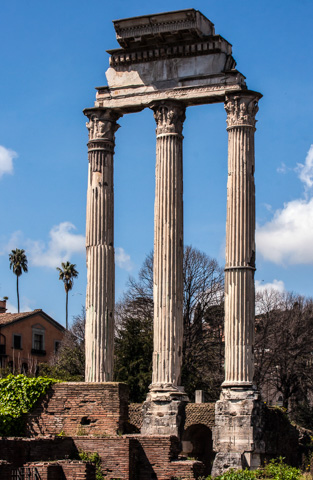
Past it are three standing Corinthian columns of the Temple of the Dioscuri, dedicated to the original gemini twins, Castor and Pollux, brothers to Helen of Troy.
After Leda made it with the swan—really Zeus/Jupiter in disguise—she laid an egg out of which hatched triplets. Helen, of course, would grow up to be a real beauty, get kidnapped, and cause the ancient Greeks to go to war with Troy to get her back.
One Trojan, Aeneas, fled his burning city, had a series of adventures (chronicled in Virgil's masterful propaganda poem The Aeneid), and eventually landed in Italy to build the city of Rome.
The Romans, counting back a few steps from their mythical founder, decided they really dug the whole Leda story.
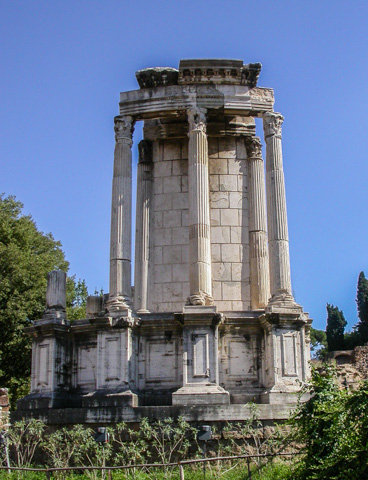
Beyond the bit of curving wall that marks the site of the little round Temple of Vesta (rebuilt several times after fires started by the sacred flame housed within), you'll find the partially reconstructed House of the Vestal Virgins (AD 3rd–4th centuries) against the south side of the grounds.
This was home to the consecrated young women who tended the sacred flame in the Temple of Vesta.
Vestal virgins were young girls (between ages six and ten) selected from patrician families to serve a 30-year priestesshood. During their tenure they were among Rome's most venerated citizens, with unique powers, such as the ability to pardon a condemned criminals.
The cult of the goddess Vesta was quite serious about the "virgin" part of the job description. If any of Vesta's earthly servants were found to have 'misplaced' their virginity, the miscreant Vestal was summarily buried alive. (Her amorous accomplice would merely be flogged to death.)
The overgrown rectangle of their gardens has lilied goldfish ponds and is lined with broken, heavily worn statues of senior Vestals on pedestals (and, at any given time when the guards aren't looking, a couple of tourists posing as Vestal Virgins on a few of the empty pedestals in between).
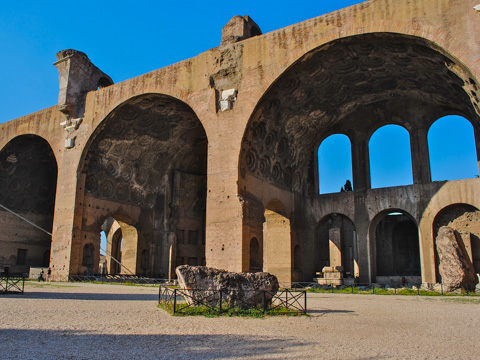
The path now dovetails back to join the Via Sacra at the entrance. Turn right, climbing between some overgrown ruins and medieval additions under the shade trees, then head left to enter the massive brick remains and coffered ceilings of the AD 4th-century Basilica of Constantine and Maxentius.
These were Rome's public law courts, and their architectural style was adopted by early Christians for their houses of worship. This is the reason so many ancient churches are called "basilicas;" technically speaking, it is a type of architecture, not a type of church.
Return to the path and continue toward the Colosseum, a visit to which is now part of the ticket that gets you into the Forum. Before you get to the Colosseum, however, veer right to the second great surviving triumphal arch in the Forum, the Arch of Titus.
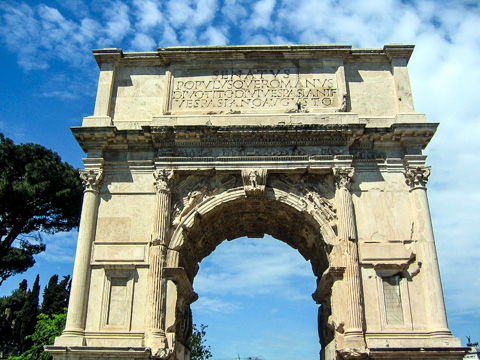
The Arch of Titus was erected to celebrate the brief—AD 79 to 81—but popular rule of Titus, son of Vespasian (remember them, the pair who built the Colosseum?).
Look closely at the time-bitten relief panels on this arch and you'll see a crowd carrying a menorah—a bit odd for a Roman sculpture, no?
The Great Revolt, a.k.a. the First Roman-Jewish War, started in AD 66. General Vespasian was set to quell it, and he tapped his son Titus, to serve as second in command.
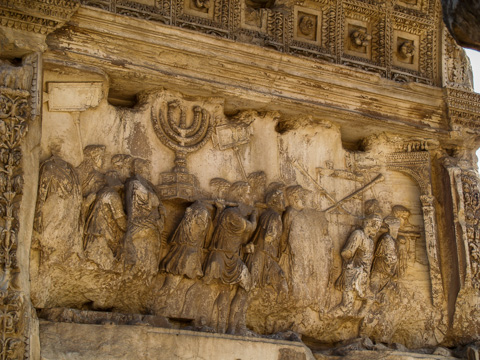
When Vespasian left for Rome (via Egypt) to take over as Emperor in AD 69, Titus decided to end the drawn-out conflict and beseiged Jersualem in AD 70.
After nearly eight brutal months, the Romans finally breached the inner wall, sacked the city, and looted Jerusalem's Second Temple of its treasures. Hence, the menorah.
Though Titus left Judea after the fall of Jerusalem and destruction of the temple, the war gliorified by this arch did not end until the grim sacrifice of the last Jewish rebels at Masada in AD 73.
The Great Revolt also kicked off a mass exodus of Jews from colonized Judea—the beginning of the Jewish diaspora throughout Europe.
For his actions, Titus is often cast as one of history's original anti-Semites, but that's a bit unfair. For him it was a simple case of Roman politics. He was sent to put down a revolt in a rebellious province. It really had nothing to do with the race or religion of the rebels in question.
If anything, it was Nero who was the anti-Semite, instigating the rebellion in the first place by favoring the immigrant Greek population of Judea over its native Jewish one. Vespasian and his son and successor Titus—both originally sent to quell the revolt—merely inherited the ensuing political firestorm.
In fact, Titus carried on a prolonged and rather scandalous affair with the Herodian Jewish princess Berenice, which he didnt break off until a decade later when he ascended to the Imperial throne in Rome.
It's also worth noting chroniclers at the time wrote that Titus actually ordered the temple itself be spared, and that its destruction was accidental (though other ancient historians disagree).
Not that his motivations made things any easier on the Jerusalemites. Titus handled the rebellion in typically brutal, all-or-nothing Roman fashion, sacking the city, slaughtering more than one million of its citizens, and enslaving nearly 97,000.
From here you can climb the Palatine Hill, or continue south to exit the Forum along a sloping road to the Colosseum.
Entrances: Via della Salaria Vecchia 5/6 (at Via dei Fori Imperiali/Via del Foro Romano) and Piazza Santa Maria Nova 53 (also: Palatine Hill entrance at Via San Gregorio 30)
tel. +39-06-3996-7700 or +39-06-0608
www.isromantique.it
or
www.coopculture.it
Daily as follows:
Last entry: one hour before closing
€12 (free first Sun of month)
Book tickets: Reserve tickets ahead of time with Select Italy:
Roma Pass: Yes (free, or 37% off)
Bus: 60, 75, 117, 53, 80, 85, 87, 175, 186, 271, 571, 810, N2
Metro: Colosseo (B)
Hop-on/hop-off: Piazza Venezia or Colosseo
Planning your day: You could wander through the Roman Forum in an hour or two, but many people spend four or five hours and pack a picnic lunch to eat on the Palatine (technically illegal; see below).
The ticket office closes one hour before the site.
Lines at the Forum can last up to half an hour in summer. To save your precious vacation time, it's well-worth paying the €1.50 fee to book your entry ahead of time (tel. +39-06-3996-7700, www.coopculture.it or at Select Italy)—though if you're visiting in off-season, the wait is usually more like 10–15 minutes so booking might not be necessary.
The regular ticket covers entry to both theRoman Forum/Palatine Hill and the Colosseum for the amazing low price of €12 (you get two days in which to visit them both).
You can buy this ticket ahead of time (and skip the lines) via Select Italy. Or buy a ticket at any of four ticket offices:
This is a fantastic deal—though also consider using this as one of the two freebies you get with the Roma Pass (you get two "get in free" coupons, and this is one of the pricier entries on the potential list, so a great choice to use a coupon on). » more
I advise against the Archeologia Card, which you will also see offered. This card covers entry to these sights (Forum & Colosseum) plus the Museo Nazionale Romano group (Palazzo Massimo alle Terme, Palazzo Altemps, Baths of Diocletian, Crypta Balbi, Aula Ottagona; normally €7–€10), and the Appian Way group (Baths of Caracalla, Tomb of Cecilia Metella, Villa of the Quintili; normally €6).
Sounds good, right? Some major-league sights in there, yes? True: But the savings is actually only €2–€5, and you can get more bang for your sightseeing buck by using the Roma Pass instead to cover the Forum/Colosseum (plus either the Museo Nazionale Romano group or something else major like the Galleria Borghese). » more
The site runs one-hour tours in English for just €5—though only Fri–Sun at 11am and 12:30pm.
Or you can take a guided tour of the Roman Forum with one of our partners:
You can rent an audio guide from the entrance for €5 that gives you context and background details and walks you through the entire Forum and Palatine Hill site in about two hours.
Share this page
Search ReidsItaly.com
Entrances: Via della Salaria Vecchia 5/6 (at Via dei Fori Imperiali/Via del Foro Romano) and Piazza Santa Maria Nova 53 (also: Palatine Hill entrance at Via San Gregorio 30)
tel. +39-06-3996-7700 or +39-06-0608
www.isromantique.it
or
www.coopculture.it
Daily as follows:
Last entry: one hour before closing
€12 (free first Sun of month)
Book tickets: Reserve tickets ahead of time with Select Italy:
Roma Pass: Yes (free, or 37% off)
Bus: 75, 117, 53, 80, 85, 87, 175, 186, 271, 571, 810, N2
Metro: Colosseo (B)
Hop-on/hop-off: Piazza Venezia or Colosseo



This article was written by Reid Bramblett and was last updated in February 2014.
All information was accurate at the time.
about | contact | faq
» THE REIDSITALY.COM DIFFERENCE «
åß
Copyright © 2008–2017 by Reid Bramblett. Author: Reid Bramblett