Stay on a working farm
The phenomenon of agriturismi—or agritourism, agrotourism, rural tourism, farm stays, guest ranches, farmhouse B&Bs, or whatever you choose to call the chance to stay on a working farm—has exploded in Italy since the 1990s.
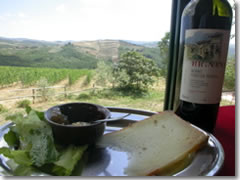
Some pecorino and a bottle of the red wine grown on those very vines in the background at La Rignana, an agriturismo in Tuscany's Chianti region.
The goose pond 30 feet from my bedroom seemed lovely... until I discovered that Honking Hour started at 6am.
La Cascina del Monastero was an agriturismo, a farm in the heart of Italy's Piemonte wine country that also offered rooms to travelers.
Some slopes around the old farmhouse were strung with grape vines, others planted with fig and olive. There was a chicken coop out back, several fruit orchards... and that infernal pond.
Booking farm stays in Italy
I got my revenge, though: Breakfast included the most delectable goose liver pâté.
Even if you can't afford your own farmhouse in Tuscany—or Umbria, or Piemonte, or Sicily, or Apulia , or wherever your Italian dream countryside resides—staying on a working farm, or agriturismo, gets you up close with the rural heart of Italy. You don’t even have to milk the buffalo for mozzarella or stomp the grapes for wine (though sometimes being a temporary farm hand for fun is an option).
What's it like to stay on an agriturimo?
I've stayed at loads of agriturismi: Vineyards and dairy farms, barns amid olive groves and frescoed villas next to horse stables.
Sometimes you just hole up for the night in a B&B converted from a farmhouse.
Sometimes you actually stick around to do volunteer work for a few days (a week, two months, a year), as with the worldwide WWOOF network. Sometimes, just renting a cottage in a rural area where sheep wander past your window is enough to count.
The rules regarding agriturismi vary from region to region, but most require that the accommodations be limited to a maximum of 30 beds, and that the owners derive a maximum of 30% of their income from lodging—this ensures they remain working farms and not devolve into countrified hotels.
More and more agriturismi are opening restaurants featuring wonderfully huge, cheap, and hearty home-cooked dinners (the standard: about €30–€45, including wine, for four or five courses).
The breakfasts are usually included in the rates—and usually excellent (freshly baked breads and pastries, homemade jams and marmalades, milk straight from the cow, so to speak). Speaking of room rates:
How much does it cost to stay on an agriturismo?
Each agriturismi stay has offered me a different experience of Italian farm life for a fraction the cost of a hotel; double rooms run anywhere from €35 to €300, but usually average around €55 to €125.
Of course, farmstays in popular regions, like Tuscany or the Piemonte wine regions, are going to cost on average more than those in Apulia or Sicily.
Many agriturismi require a three-night minimum stay (for some, a week).
Roughly half accept credit cards.
What are the rooms like at an agriturismo?
Sometimes you get four-star luxury and satellite TV. Sometimes you’re a straw's-width from sleeping in a stall. Most, though, are just what you'd expect from a farmhouse B&B: roomy and comfortably rustic, with simple comforts, solid country furnishings, and rural tranquility—barnyard noises excepted.
The hosts tend to be a sight friendlier than your average hotel desk clerk. Some invite guests to dine with them, family-style, in the farmhouse. One shepherd let me stir a bubbling pot of sheep's milk to help it on its way to becoming pecorino cheese. Vineyard owners love to crack open bottles of their best to guide you through the finer points of wine tasting, which brings me back to that farm in Piemonte.
Some favorite agriturismo meals
Even better news is this: More and more agriturismi are opening restaurants featuring wonderfully huge, cheap, and hearty home-cooked dinners.
These usually consist of four or five hearty courses of food fresh from the fields and pastures just outside your window and often ringing it at a mind-blowingly inexpensive €30 to €45 per person for everything, including wine (table wine, of course, but one produced on-site, at a neighbor's, or at least by a member of the extended family).
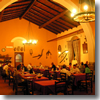 Even those agriturismi that don't offer a restaurant for dinner almost always do breakfast—usually included in the rates and almost always excellent: a farmer's spread of freshly baked breads and pastries, homemade jams and marmalades, milk straight from the cow (so to speak), fresh fruits, and more
Life on the Farm—Italian style
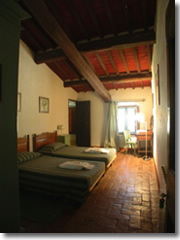
A country-comfy room at an agriturismo in Tuscany's Chianti region.Friendly vineyard owners is how I ended up, at La Cascina del Monastero, sitting on the back patio with Giuseppe and Velda di Grasso until well past midnight, sampling bottles of Barbera, Nebbiolo, and Barolo culled from the ghostly, moonlit rows of vines around us.
Their seven-year-old son played shy until he found out I was from Philadelphia. "Just like the cheese!" He said. His parents laughed, shooed him off to bed, and explained that American cream cheese was a current fad in Italy.
Our talk drifted to the subject of agriturismo itself, how it has become a way for farmers to make ends meet, and how family vintners even in this storied, storybook corner of Italy are having a rough time in this era of shrinking subsidies and growing wine conglomerates. Giuseppe told me of a neighbor who had recently died in a tractor accident.
"The family doesn't know how it can keep the vineyard," he said. Velda said she still shudders to imagine the poor wife, explaining to their nine-year-old son that his father was gone and never coming back. Giuseppe leaned forward in his chair with a sober look.
"The morning after he died, the widow was woken up by the sound of machinery," he said. "She went into the cellar to find her son running the grape press. She asked what on earth he was doing, and he said 'Papá is gone. Now it is up to me to make the wine.'"
Velda shook her head and excused herself. Giuseppe and I stayed up an hour longer, draining the last bottle and talking of happier things. As I climbed the outer stairs to my room, Giuseppe mentioned that he'd be leaving early tomorrow for a business trip, but would leave breakfast out for me.
Next morning, after my clamorous 6am wake-up call, I padded down into the great room to find a sumptuous spread of cheeses and prosciutto, warm bread, homemade marmalade, fresh-squeezed orange juice, and milk so fresh it mooed. There was a clanking noise coming from behind a pair of giant barn doors, and I cracked them open to peek inside.
The Di Grassos' young son was in there, running the bottling machine, making the wine while Papá was gone.
How to find agristurismi
Every local tourist office has lists of local farm stays. Few are listed in English-language guidebooks.
There are usually agriturismo guides available in local bookshops. These are usually only in Italian, but the important bits are easy enough to figure out: addresses, prices, and phone numbers, photographs, and icons denoting private baths, swimming pools, etc.
You can always just look for the ubiquitous agriturismo signs on country roads (traditionally brown or yellow, but lately they come in all colors), pointing you down rutted dirt tracks toward a farmhouse set among the vineyards.
However, if you want to find and book a few before you leave, here are the best resources for finding farm stays in Italy.
 Hotels.com (www.hotels.com) - Good generalist site with plenty of farm stays under "Country House."
- Booking.com (www.booking.com) - Another good generalist hotel booking engine that lists agriturismi under "Farm Stays" in the "Hotel Type" filter for nearly every desitnation.
- Official Italy agriturism sites (www.terranostra.it, www.turismoverde.it, www.agriturist.it) - The three major national agritourism organizations/databases. Unfortunately, only that last one (Agriturist) has an English-language version of the site available; the others are in Italian only, but, again, its pretty easy to click your way through the geographic organization and suss out the page details. On Terranostra, click on "cerchi un agriturismo" (search for a farm) at the bottom of the page. From there it's all maps and drop-down lists (so you could select, for example, the regione of Toscana, then the provincia of Siena, then the comune of San Gimignano). At Turismo Verde, click on "Guida" (guide) along the top bar; the next page will list all the regions on the left, and it's maps and lists from then on.
- Unofficial Italy farmstay sites (www.agriturismo.net, www.agritour.net, www.agriturismo.com, www.agriturismo-sicilia.it) - Unofficial, yes, but still darned useful, and more likely to be in English.
Tips & links
Farm stay links & resources
Other lodging links & resources
Useful Italian
Useful Italian phrases and terms for lodging
| English (Inglese) |
Italian (Italiano) |
Pro-nun-cee-YAY-shun |
| Good day |
Buon giorno |
bwohn JOUR-noh |
| Good evening |
Buona sera |
BWOH-nah SAIR-rah |
| Good night |
Buona notte |
BWOH-nah NOTE-tay |
| Goodbye |
Arrivederci |
ah-ree-vah-DAIR-chee |
| Excuse me (to get attention) |
Scusi |
SKOO-zee |
| thank you |
grazie |
GRAT-tzee-yay |
| please |
per favore |
pair fa-VOHR-ray |
| yes |
si |
see |
| no |
no |
no |
| Do you speak English? |
Parla Inglese? |
PAR-la een-GLAY-zay |
| I don't understand |
Non capisco |
non ka-PEESK-koh |
| I'm sorry |
Mi dispiace |
mee dees-pee-YAT-chay |
| |
|
|
| Where is? |
Dov'é |
doh-VAY |
| ...a hotel |
un albergo |
oon al-BEAR-go |
| ...a B&B |
un bed-and-breakfast |
oon bet hand BREK-fust |
| ...a rental room |
un'affittacamera |
oon ah-feet-ah-CAH-mair-ra |
| ...an apartment for rent |
un appartamento |
oon ah-part-tah-MENT-toh |
| ...a farm stay |
un agriturismo |
oon ah-gree-tour-EES-moh |
| ...a hostel |
un ostello |
oon oh-STEHL-loh |
| |
|
|
| How much is...? |
Quanto costa? |
KWAN-toh COST-ah |
| a single room |
una singola |
OO-nah SEEN-go-la |
| double room for single use [will often be offered if singles are unavailable] |
doppia uso singola |
DOPE-pee-ya OO-so SEEN-go-la |
| a double room with two beds |
una doppia con due letti |
OO-nah DOPE-pee-ya cone DOO-way LET-tee |
| a double room with one big bed |
una matrimoniale |
OO-nah mat-tree-moan-nee-YAAL-lay |
| triple room |
una tripla |
OO-nah TREE-plah |
| with private bathroom |
con bagno |
cone BAHN-yoh |
| without private bathroom |
senza bagno [they might say con bagno in comune—"with a communal bath"] |
SEN-zah BAHN-yoh |
| for one night |
per una notte |
pair OO-nah NOH-tay |
| for two nights |
per due notti |
pair DOO-way NOH-tee |
| for three nights |
per tre notti |
pair tray NOH-tee |
| Is breakfast included? |
É incluso la prima colazione? |
ay in-CLOO-soh lah PREE-mah coal-laht-zee-YOAN-nay |
| Is there WiFi? |
C'é WiFi? |
chay WHY-fy? |
| May I see the room? |
Posso vedere la camera? |
POH-soh veh-DAIR-eh lah CAH-mair-rah |
| That's too much |
É troppo |
ay TROH-po |
| Is there a cheaper one? |
C'é una più economica? |
chay OO-nah pew eh-ko-NO-mee-kah |
Share this page

Search ReidsItaly.com