Renting a car
Hit the Road, Jacques: Hints, tips, resources, and pointers for getting your own set of wheels in Europe and elsewhere while traveling
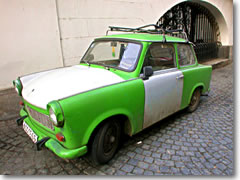
Just make sure you read the fine print on that "sub-compact" or you may end up with a Trabant, the endearingly cute dead-end of the old East German auto industry.The wind in your hair, the autobahn stretching before you, the freedom to explore at will, the fact that speed limits are fairly optional... Renting a car is the only way to see all of Europe's nooks and crannies.
There is a lot to recommend renting or leasing a car in Europe, especially if you want to go beyond just the big cities (and you should).
I love European trains, and no-frills airlines make crossing great distances in Europe fast and cheap (albeit thoroughly unromantic). But sometimes, only your own set of wheels will do.
The upsides to renting a car
The main argument for plunking down a big chunk of your vacation budget on an auto rental is that glorious freedom to spread out a map, cross-reference the little towns on it to your guidebook—or just to your whims—and then turn left down any road that catches your fancy.
Driving is by far the best, and often the only reasonable, way to get off the beaten path and see the places in between—to visit vineyards, drop by medieval hamlets, and explore crumbling countryside castles.
With a car, you can be your own travel boss and get away from the tyranny of the train schedules which define the structure of the traditional tourist trail.
Renting (or leasing) is really the only reasonable option if you want to explore any small region in depth. The beaten path in Europe is lined with railroad tracks and plied by intercity coaches and air-conditioned tour buses. If you want top get off it, you’ll need your own wheels (or a heck of a lot of time and either a bike or sturdy walking shoes.)
The downsides to renting a car
Of course, with a car comes hassles. You'll have to deal with aggressive drivers, navigate nerve-racking and confusing city traffic where the system of one-ways and seem to follow some arcane and indecipherable set of rules while the other drivers seem to follow none, and of course find and then pay (often through the nose) for parking whenever you stop.
If you're constantly behind the wheel of an automobile, you aren't free to relax and do research on the long journeys between towns (as you would on a train, bus, or plane), and the gasoline prices in other countries will downright curl your toenails, often costing three or four times as much as in the States.
Still, unless you walk or bike, there's no way to get closer to the land, its people, and its small towns devoid of other tourists and have the true freedom to go where your travel dreams take you than to rent a car.
Decisions, Decisions: Which is better, a rental car or public transportation (trains, buses, planes, etc.)
Is a car right for you? Would a railpass and the train system be better than a rental car? That varies trip to trip and depends on what you want to accomplish on yours. In brief:
- If you want to cover lots of ground, concentrate on the cities, or are going it solo, nine times out of ten I’d say take the train or a train/no-frill airline combo.
- If you're exploring a single country or region, plan to hit lots of small towns, and are in a party of three or more, then rent a car (in general, three people splitting one car rental is cheaper than buying three train tickets).
- The best trips mix and match transportation a bit. For example, you can take the train to Florence, and then drive through the vineyards and hill towns of Tuscany to Rome. This is why rail-and-drive passes can make a lot of sense.
If you see just the major cities of Europe, you're missing out on a big part of the continent, and I heartily recommend breaking up the metropolis itinerary with some jaunts through the countryside to smaller towns. It'll add spice and variety to your trip.
Related Articles |
Related Partners |
This article was by Reid Bramblett and last updated in April 2011.
All information was accurate at the time.
Copyright © 1998–2013 by Reid Bramblett. Author: Reid Bramblett.

 |
- Trip Planning
- Getting there
- Getting around
- Where to stay
- Hotels
- Alternative accommodations
- Agriturism / farm stays
- Apartments
- B&Bs
- Camping
- Castles
- Chains
- Convents
- Cottages/gîtes
- CouchSurfing
- Crash-ins
- Crewing a boat
- Dude ranches
- Sleep for free
- Historic inns
- Home swapping
- Hospitality exchange
- Hostels
- Hotels
- House sitting
- Monasteries
- Motels
- Mountain huts
- Overnight trains
- Rental rooms
- Residences
- RVing
- Schlaf im stroh
- Servas
- Sleeping in airports
- Universities
- Villa rentals
- WWOOFing
- Reid's recommended hotels
- Sleep for free
- What to see & do
- Planning your time
- Packing
- Paperwork & passports
- Getting info
- Communications
- Safety & crime
- Health & insurance
- Money & shopping
- Destinations
- Adventures
- Sponsor:
The Travel Store        |
Consolidator: Autoeurope.com.
Booking engines: Orbitz.com
Short-term leases: Autoeurope.com, Europebycar.com, Renaultusa.com.
Resources: AAA.com, Theaa.com.