How to beat jet lag
Truth is, there is no cure for jet lag, just ways to make it easier to bear and quicker to dissipate
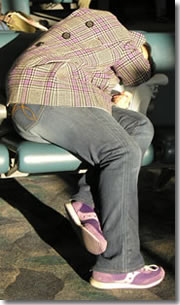
Getting as much sleep as you can on the plane (or even in the airport) is vital to overcoming jet lag when you arrive.
Everyone and their guidebook has a homespun remedy for overcoming the inevitable jet lag that occurs when you land in Europe and your watch says 7am but your body says 1am (the fact that you managed to do no more than doze fitfully on the plane ride over doesn't help).
I don't go in for all that jazz about melatonin—no, not the stuff in your skin than makes you look tanned, but a hormone that's naturally released by your pineal gland at bedtime and that helps regulate sleep cycles. It is now sold in pill form as a sort of natural sleeping pill and body clock-resetting device.
If you're convinced—and overcoming jet lag is 50% attitude anyway, so whatever you think works best does tend to work—ask your doctor about it. If it works, drop me a line and maybe I'll give it a go and change my mind.
Then again, some people never feel jet leg. These people deserve a beating.
More practical, though, would be to make them carry your stuff for the first few days while they're chipper and you're still zonkered.
Tips for sleeping on the plane
OK, first things first: even with the advice below, you probably won't truly sleep on the plane.
Chances are, the best you'll manage is to doze fitfully on the plane ride.
Accept that and you won't get as frustrated, because the frustration of not being able to sleep makes it way harder to catch those cat naps that are crucial during long plane flights.
Here are 24 ways to increase your odds of sleeping on the plane—aside from the obvious: booking business class or first class, which will give you a huge head-start on comfort when using all of these techniques (and put a huge dent in your travel budget).
No matter where you can afford to sit, these tips will help you catch some shut-eye.
The seat
- Pick a seat that reclines. Avoid seats in front of a bulkhead or bathroom—they have no room to recline (plus, the sounds and smells from the bathroom can be, er, quite disturbing).
Exit row seats may have more legroom, but for safety purposes they often don't recline all the way (neither do seats directly in front of the exit rows, so that they won't block access to the exits—the worst of both worlds).
Also, seats in exit rows and in front of bulkheads are often a bit narrower (this because the armrests are extra-wide to accommodate the tray tables that, in other rows, are on the seatback in front of you).
You can learn about the various merits (and downsides) of every single seat on every plane by entering in your airline and flight number at SeatGuru.com or SeatExpert.com.
- Pick the window seat. Though I normally prefer the aisle (so I don't have to ask permission from my neighbor to get up), on overnight flights I often book a window seat. This allows me to snuggle up to the side of the plane, wedging myself between the seatback and the wall to help provide support while I sleep.
True, it takes an artful arrangement of pillows, inflatable neck braces, and blankets to get the padding just right (against the wall, over the armrest, and as support behind my back), but when it works it's golden.
- Find a seat in the middle of the plane. You want to be as far as possible from the galley and the bathrooms. They are both high-traffic areas.
Flight attendants usually try to be politely quiet during night flights, but they are working, after all, and the galley is their in-flight office, so there will be noise.
Far worse, fellow passengers waiting in line to use the bathroom tend to chat and lean on your headrest. It is rude, and unthinking, and annoying as anything, but they still do it.
The gadgets
- Noise-canceling headphones. This is the one seemingly silly travel gadget I actually use. These things really do make flying less stressful—and they do it on a biological level. The low frequency, often subsonic roar of the jet engines can raise your autonomic stress levels, putting your body into a slow-burn version of the classic fight-or-fllght reaction (no pun intended), which basically means you're dripping a constant trickle of adrenaline into your system.
Not only does this make it terribly hard to sleep, but then, once when the plane lands and the roar subsides, the adrenaline shuts off and you crash. This is what we call "jet lag." And that's how these headphones work.
If you put them on at home, you hear nothing more than a faint hiss, but in the sky they actively cancel out the ambient noise (and that subsonic roar), disrupting the whole stress-induced cycle.
Also, they make it way easier to hear the movie.
There are tons of models available. I currently rock a JVC HANC250—1/3 the price of the Bose; just as good.
- Earplugs. Low-tech version of the noise-canceling headphones. Personally, I can't stand to have these things shoved in my ear canals—they make my eyes water and drive me batty—but many folks swear by them.
- Neck pillow - Inflatable kinds pack much smaller than bean-filled
or memory foam types, though some find the latter to be more comfortable. Some prefer the all-around-the neck style (inflatable or memory foam) to the old horseshoe collar. Or you can go for the big guns: The SkyRest Travel Pillow
, that famous "inflatable box" pillow from the SkyMall catalog that you balance on your lap or tray table so you can sleep leaning forward. It works—kinda, though after a while I get tired of sleeping slumped forward. Actually, it comes in remarkably handy as a foot-rest/ottoman instead (which helps ben more by making your body that much more horizontal).
- Eye masks. These really do help (I was converted after a few trips to Arctic and Antarctic latitudes where the sun never sets). Try a couple of styles at home to see which works best for you. The cheap, flimsy cloth ones work fine for some people, but others find them too rough, too tight—touching your eyelids so much they're bothersome—or so loose they let in too much light to be worth bothering with. The slightly fancier, cushioned kind linked to here avoids all of these drawbacks.
- Your own blanket or shawl. These days, blankets are often in short supply on many airlines—first come, first served—and on some airlines they actually charge you for the blanket and pillow. Plus, the in-flight blankets somehow manage to be thinner than a cotton sheet, so for more warmth and comfort—not to mention guarantee you'll actually have a blanket— you might want to bring your own—either a real blanket, or at least a light shawl (which can conveniently double as modesty shawl for entering churches and such).
The drugs
- Avoid alcohol. Don’t try to drink yourself into a stupor. This strategy will only backfire. Alcohol and flying don’t mix well. Booze exacerbates the effects of jet lag (and of fruitlessly hitting on the flight attendants) and only hastens dehydration. Also, the oblivion brought on by drinking is not a restful one. You may be unconscious, but you're not sleeping.
- Try jet lag remedies. The are both prescription remedies (melatonin) and homeopathic pills (No-Jet-Lag
- Pop an Ambien or other prescription sleep aid. Only use the big guns like this with a doctor's prescription. Try one at home first to see how you react. Take it only after you've taken off. Only use it on flights longer than 7 hours (to give it time to wear off). That said: boy, howdy, does this stuff work.
The strategy
- Get a full night's sleep the night before your flight. Some people reason that, since it would easier to sleep on the plane if they're dog-tired, it makes sense to skip sleeping the night before the flight. This is monumentally unsound logic, and a dumb thing to do. All it does is ensure you'll be losing two decent nights' sleep. Try to go to bed early the night before your trip, and sleep in late, if possible. (After I trained myself to pack a full day in advance, so at least that isn't keeping me up the night before, it made life so much easier—though I do backslide a lot.)
- Ignore the in-flight entertainment. No movies, no working on your laptop. Just bring a dull book and an iPod playlist of light, easy music like classical, light jazz, or modern orchestral—Phillip Glass, Michael Nyman, the quieter pieces from film scores, etc.
- Stay hydrated. Planes are insanely dry places, making it hard to sleep (after even a 15 minute catnap, I always wake up with a terrycloth tongue and Sahara throat, gasping for water) and worsening the effects of jet lag. Keep a water bottle in your seatback pocket so a refreshing swig is always only an arm's reach away. Top it off in the galley every time you get up; most flight attendants are happy to fill your personal bottle, though some airlines—apparently to keep a lid on supply levels—have a policy that does not allow this (Lufthansa: shame on you).
- Avoid caffeine drinks. This one should be screamingly obvious.
- Work out the wiggles. It's hard to go to sleep when your body wants to move around and shake off the torpor of sitting still for long periods. So get up and walk a few laps of the plane. Do some toe-touches in the galley at the back where you're out of everyone's way. Yes, this will get your blood circulating (and, incidentally, help fight off the dreaded DVT), which seems counterproductive since you want to calm down, not rev up. However, this is a mild effect that won't last long, while the effect of loosening your muscles and calming your nerves will last much longer and do wonders for helping you get to sleep.
- Try meditating. You needn't download Krishna Das to your iPod (though do try recorded meditation and see if that works for you). All you have to do is close your eyes and concentrate on your breathing. Keep it slow and steady; in through the nose and out through the mouth. Tense, then relax, each muscle in your body one at a time, starting with your toes and working your way up.
- Don't be afraid to wake up. When you wake up (and you probably will repeatedly), stretch and twist, roll your head and neck around and around, and make "fists" with your fingers and toes. This will work out all the kinks and get the blood flowing before trying to go back to sleep so your body stays comfortable. Trust me: it'll help.
- Minimize disturbances. You'd think that the eye mask, headphones, and neck pillow would be a strong enough signal to the rest of the plane that you'd like to be left alone, but don't count on it. While I can't offer a deterrent to keep the Chatty Cathy next to you from talking off your ear, I do have some advice you can deploy people more attuned to subtle social signals:
- Let the flight attendants know that sleep is your priority. When the initial drinks service comes around (so you know which attendant is assigned to your row), politely ask him or her not to wake you for anything—not drinks service, the "morning" lights-on in the plane, breakfast, a snack, or anything—until it is time to return the seat back to its upright position in preparation for landing. Trust me: I've eaten airline food; you're not missing anything. In fact, this way's better.
- Leave your tray table closed. This is airline equivalent of hanging a "do not disturb" sign.
- Buckle your seat belt over your blanket. This way flight attendants won't wake you to ensure you're buckled in safely. (If you forget this step and they do wake you, try not to be too cranky about it; they're just doing their job. Grumpy is OK; cranky, not.)
- Let the flight attendants know that sleep is your priority. When the initial drinks service comes around (so you know which attendant is assigned to your row), politely ask him or her not to wake you for anything—not drinks service, the "morning" lights-on in the plane, breakfast, a snack, or anything—until it is time to return the seat back to its upright position in preparation for landing. Trust me: I've eaten airline food; you're not missing anything. In fact, this way's better.
- Try to reset your clock to the local schedule. Start resetting your internal clock before you leave by getting up and going to bed a bit earlier or later than usual (whichever direction is moving you closer to the time zone you'll be visiting).
Once you're in the new country, expose your face to bright sunlight for the first few mornings. Your body knows how to reset its own internal clock if you let it.
Go to bed at a decent time according to the clocks of the country you're in, not what your body tells you (try for 10pm; don’t stay up past midnight). Wake up at a normal time the next day—even when your alarm beeps that it's 8am, but your tired body is telling you it's 2am.
- Do not nap when you arrive! I know the temptation is strong, especially by mid-afternoon on that first day when you look like a tourist zombie stumbling around the Louvre with a thousand-yard stare. Do not give in! The only way to reset the body clock is to force it into the new time zone.
After two or three days, feel free to indulge in that most excellent Mediterranean habit of a nap after lunch. Until then: eyes open, back straight, and plow through each day to the end.
My advice: keep the first day's sightseeing light, easy on the brain and feet, and short. have an early dinner, head back to the hotel by 7 or 8pm, and tumble into bed to get that full night's sleep denied you on the plane.
Related Articles
|
|
This article was by Reid Bramblett and last updated in June 2012.
All information was accurate at the time.
Copyright © 1998–2013 by Reid Bramblett. Author: Reid Bramblett.

 |
- Trip Planning
- Getting there
- Getting around
- Where to stay
- Hotels
- Alternative accommodations
- Agriturism / farm stays
- Apartments
- B&Bs
- Camping
- Castles
- Chains
- Convents
- Cottages/gîtes
- CouchSurfing
- Crash-ins
- Crewing a boat
- Dude ranches
- Sleep for free
- Historic inns
- Home swapping
- Hospitality exchange
- Hostels
- Hotels
- House sitting
- Monasteries
- Motels
- Mountain huts
- Overnight trains
- Rental rooms
- Residences
- RVing
- Schlaf im stroh
- Servas
- Sleeping in airports
- Universities
- Villa rentals
- WWOOFing
- Reid's recommended hotels
- Sleep for free
- What to see & do
- Planning your time
- Packing
- Paperwork & passports
- Getting info
- Communications
- Safety & crime
- Health & insurance
- Money & shopping
- Destinations
- Adventures
- Sponsor:
The Travel Store        |
Consolidators: AutoEurope.com, CheapTickets.com, CheapOair.com, OneTravel.com, Airfareplanet.com, Tfitours.com, Economytravel.com, Amta.com, DFWtours.com
Booking engines: Orbitz.com, Expedia.com, Travelocity.com
No-frills airlines: Momondo.com, Skyscanner.net, Wegolo.com, Mobissimo.com; Lowcostairlines.org, Attitudetravel.com
Vacation packages: Gotoday.com,Orbitz.com, Expedia.com, Travelocity.com, AutoEurope.com, Southwestvacations.com, Gate1travel.com, TourCrafters.com, Untours.com
Opaque fares: Priceline.com, Hotwire.com (advice on bidding: Bidontravel.com, Biddingfortravel.com, Betterbidding.com)
Fare alerts: Bing.com, Yapta.com, Airfarewatchdog.com, Farecast.com, Farecompare.com
Deals newsletters: TravelZoo.com, Bookingbuddy.com, Budgettravel.com, Smartertravel.com, Frommers.com/blog
Student airfares: Statravel.com, Studentuniverse.com, Onetravel.com, Ciee.org, Travelcuts.com (Canada)
Airline alliances (for frequent fliers): Skyteam.com, Oneworld.com, Staralliance.com
Airports: Atlasnavigator.com, Expedia.com/daily/airports, Sleepinginairports.net
Airport transfers: Viator.com