Gypsies
A traveler's guide to spotting and foiling gypsy pickpockets in Europe
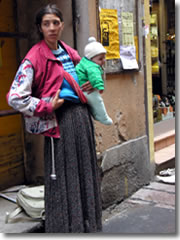
A gypsy woman begging—with an infant for bonus sympathy points—outside a market in Bologna, Italy.
First off, I've got nothing against the Roma or Romany people—which are the proper names for the traditionally semi-nomadic people originally (according to most theories) from south-central Europe that are commonly referred by the slightly derogatory term "gypsies."
As with any group of people, the vast majority of Romany are decent, hard-working folks. The problem is that it is unlikely you will meet any of these (or that, if you do, you won't even know they are Roma any more than you'd "know" whether a random person on the street might be Italian, or Bulgarian, or Albanian).
This is a brief essay about those Romany that, as a tourist in Europe, you are likely to notice and single out. These are the ones who dress the part (see below) and hang around tourist-heavy spots like major sights and transportation hubs for one reason only: to squeeze money out of you.
They tend to take one of two tracks to this end. One is begging, which is fine. The other is pickpocketing, which is not so fine.
Of course, there are pickpockets and thieves of all races, creeds, and colors working all the tourist spots of the world. However, since the "gypsy" thieves are so easy to spot—and most of their techniques so easy to avoid or foil—here's a quick rundown of common schemes.
How to spot a gypsy
The anthropological explanation for the tradition of Gypsy thievery
OK, one verison goes like this. In the Middle Ages, some of the Romany considered themselves to be descended from Lilith, Adam's first wife in the Garden of Eden.
Adam found Lilith too uppity—she was an early women's libber, refusing to be subserviant to Adam—and asked God for a more pliant wife.
After another false start (Adam watched God make another woman from dust, as he had done with Adam, was mightily disgusted, refused this nameless Second Woman, and she faded away), a frustrated God put the picky Adam to sleep, plucked out one of his ribs, and spun it into Eve.
The familiar serpent, forbidden fruit, and expulsion from the garden episode then ensued... but Lilith wasn't part of this whole flaming sword drama.
Since Lilith never committed original sin, and hence never fell from God's grace, her descendents are free to do whatever they like to those sinners who descended from Eve—which is to say the rest of us.
Hey, I didn't say it made any sense; it's just anthropology.
These "tourist zone gypsies" are often easy to spot for their colorful but dirty and ragged clothes, often (with the women) in multiple layers of thin scarves and shawls.
Gypsies are most prevalent in Southern Europe, but you’ll find them everywhere—especially around major tourist attractions like Rome's Colosseum or in the Latin Quarter in Paris.
The adults mainly beg—and are very pushy about it. No problem. Give or not at your discretion.
It's the kids you really have to look out for. They’ll often swarm you, babbling excitedly and sometimes holding up bits of cardboard with messages scrawled on them in English to distract you.
Then, faster than you can say “Hey!...”, they'll rifle your pockets while the cardboard shields their hands from view.
Near walls and in metro (sybway) tunnels, they’ll even be so bold as to pin you against the wall with the cardboard so as to fleece you more easily.
They aren’t really physically dangerous, but they are very adept at pinching your stuff, and they’re damn tough to catch. The best defense is to be on the lookout.
If a group of scruffy children approaches, jabbering, yell “No!” forcefully, glare, and keep walking.
If they persist, yell “Politz!” (which is close enough in any language).
If they get near enough to touch you, push them violently away—don’t hold back just because they’re kids. Take a page from my dad's book, a technique he invented on the fly while strolling through a Rome metro tunnel with two month's rent in cash in his pocket when, suddenly, we were beset by gypsies: Act just a wee bit crazy.
Jump up, do a full spin, and come down in a karate stance with a primal scream. Dad sure didn't win awards for his Bruce Lee impression (and I doubt the gypsies seriously thought he knew karate), but those kids bugged their eyes and scattered but fast.
They prefer befuddled, clueless-looking targets and would rather steer clear of the wackos.
(For more of my dad's traveler's crime-fighting
techniques, see the page on losing things.)
Related articles |
Related Partners
|
This article was by Reid Bramblett and last updated in March 2012.
All information was accurate at the time.
Copyright © 1998–2013 by Reid Bramblett. Author: Reid Bramblett.

 |
 |
- Trip Planning
- Getting there
- Getting around
- Where to stay
- Hotels
- Alternative accommodations
- Agriturism / farm stays
- Apartments
- B&Bs
- Camping
- Castles
- Chains
- Convents
- Cottages/gîtes
- CouchSurfing
- Crash-ins
- Crewing a boat
- Dude ranches
- Sleep for free
- Historic inns
- Home swapping
- Hospitality exchange
- Hostels
- Hotels
- House sitting
- Monasteries
- Motels
- Mountain huts
- Overnight trains
- Rental rooms
- Residences
- RVing
- Schlaf im stroh
- Servas
- Sleeping in airports
- Universities
- Villa rentals
- WWOOFing
- Reid's recommended hotels
- Sleep for free
- What to see & do
- Planning your time
- Packing
- Paperwork & passports
- Getting info
- Communications
- Safety & crime
- Health & insurance
- Money & shopping
- Destinations
- Adventures
- Sponsor:
The Travel Store        |
Travel health insurance: Squaremouth.com, Insuremytrip.com, Travelguard.com, Medexassist.com, iamat.org, Medjetassist.com
Governmental travel warnings & destination safety dossiers: Travel.state.gov(USA), USA.gov (USA), Fco.gov.uk (UK), Voyage.gc.ca (Canada), Smartraveller.gov.au(Australia), Safetravel.govt.nz (New Zealand)
Embassy/Consulate finders: Embassyworld.com, USembassy.state.gov
Ttravel tips for women:Gutsytraveler.com, Journeywoman.com, Boldlygosolo.typepad.com, Womentraveltips.com, Girlsguidetotheworld.com, Womenwelcomewomen.org.uk