European Currencies
Dealing with the euro—and those countries not yet in the euro zone: the British Pound, Swiss Franc, and all those Scandinavian and Eastern European currencies
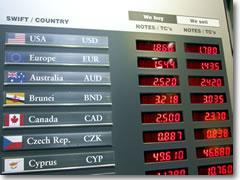 The exchange rate between the U.S. dollar and other currencies fluctuates constantly. Make sure you're getting a good rate (and low commission) whenever changing money.
The short version: Most of Western Europe now uses the euro (its symbol is: €), including Austria, Belgium, Cyprus, Finland, France, Germany, Greece, Ireland, Italy, Luxembourg, Malta, the Netherlands, Portugal, Slovakia, Slovenia, and Spain.
Just a few years ago, you could get a Euro for less than 90¢, but as of this writing (late 2011), the euro has been on a five-year winning streak while at the same time the U.S. dollar has slumped (which is the polite way of saying "tanked"), which means that it currently takes between $1.30 and $1.50 to buy €1 . Ouch.
(Even worse: A British Pound can cost anywhere between $1.55 and $2.10.)
Here's more on changing money.
Countries that do not use the Euro
- The UK—The British Isles have never been keen to play with the other European countries (witness their refusal to participate in Eurail passes). I blame it on that complicated British superiority/insular inferiority complex. That means England, Scotland, Wales, and Northern Ireland still cling to the British pound.
- Switzerland—The famously neutral Swiss never joined the EU in the first place, so they keep their Swiss Francs and their famously secret numbered bank accounts.
- Scandinavia—Only Finland is using the euro. EU members Denmark and Sweden have chosen, for now, to hold onto their national currencies. Norway and Iceland were never part of the EU to begin with. Conveniently (and confusingly) enough, all of their currencies are named, essentially, "krona"—through the Danes spell theirs "krone" while the Norwegians favor "kroner." That doesn't mean they are interchangeable. Far from it. In fact, it takes nearly nine Icelandic krona to buy a single Swedish krona. The practical upshot is: everything in Scandinavia is expensive, no matter what currency you're using. (Great health care systems, though.)
- Eastern Europe—The lands from behind the old Iron Curtain are still struggling to make their economies as robust as those of their westerly neighbors, with varying degrees of success. Recently, ten of them cleared the first hurdle to re-integrations with the rest of Europe and were accepted into the EU. That means they will be eligible to join the Euro once they meet certain economic requirements—Cyprus, Malta, Slovakia, and Slovenia passed the test as of 2008 and went on the Euro standard. The other countries-in-waiting are (roughly in order of economic strength): Poland, the Czech Republic, Hungary, Croatia, Estonia, Latvia, and Lithuania. For now, though, all of those—plus their non-EU neighbors—retain their various national currencies.
Related articles |
|
This article was by Reid Bramblett and last updated in November 2011.
All information was accurate at the time.
Copyright © 1998–2013 by Reid Bramblett. Author: Reid Bramblett.

 |
- Trip Planning
- Getting there
- Getting around
- Where to stay
- Hotels
- Alternative accommodations
- Agriturism / farm stays
- Apartments
- B&Bs
- Camping
- Castles
- Chains
- Convents
- Cottages/gîtes
- CouchSurfing
- Crash-ins
- Crewing a boat
- Dude ranches
- Sleep for free
- Historic inns
- Home swapping
- Hospitality exchange
- Hostels
- Hotels
- House sitting
- Monasteries
- Motels
- Mountain huts
- Overnight trains
- Rental rooms
- Residences
- RVing
- Schlaf im stroh
- Servas
- Sleeping in airports
- Universities
- Villa rentals
- WWOOFing
- Reid's recommended hotels
- Sleep for free
- What to see & do
- Planning your time
- Packing
- Paperwork & passports
- Getting info
- Communications
- Safety & crime
- Health & insurance
- Money & shopping
- Destinations
- Adventures
- Sponsor:
The Travel Store        |
ATM locators: Mastercard.com, Visa.via.infonow.net
Credit cards with low foreign transaction fees: Capitalone.com, Hsbc.com, Providian.com
Financial institutions and credit cards with no or low foreign transaction fees: Credit unions & Local banks (Creditunion.coop, Moveyourmoneyproject.org, Findabetterbank.com, Ncua.gov, Credituniondb.com); Online-only banks (Usaa.com , Ally.com, Schwab.com, Ingdirect.com), major bank with 0% fee (Capitalone.com); major banks with 1% fee (Hsbc.com, Providian.com
Good intel on cards & travel money issues: FlyerGuide.com, Bankrate.com, Cardhub.com, Creditcards.com
Traveler's Checks: Aaa.com, Americanexpress.com, Thomascook.com
Wiring money: Westernunion.com, Moneygram.com, Xoom.com
U.S. Customs: cbp.gov
Duty Free: Thedutyfreepriceguide.com
VAT and tax refunds: global-blue.com, Premiertaxfree.com