Travel Unplugged
In a perfect world, you'd travel without electronics...
But in this world, you have to charge the batteries on your digital camera, cell phone, laptop, handheld...
Currents, voltage, and the traveler
American current runs 110V, 60 cycles. Europe runs 210 to 220V and 50 cycles.
Technically, you can't plug a standard American appliance into a foreign outlet without frying your appliance and/or blowing a fuse. You need a currency converter or transformer to bring the voltage down and the cycles up.
Luckily, most modern devices designed to travel have the converter built in: iPods, laptops, digital cameras, hairdryers, etc. Check the bottom panel, the script embossed in the plastic of the charger plug, or the instruction manual to be sure.
Square Pegs, Round Holes
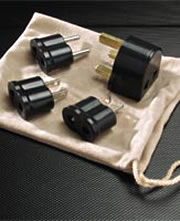
Plug adaptors make the two flat prongs of a US electronic device fit the two round pin-holes (or three slanted flat plugs of England) in Europe.
Even if your device has a converter built in, you still can't plug an American appliance into a foreign wall because it just plumb won't fit.
American plug prongs are flat and parallel. Most of Europe uses two round pins (the U.K.—and some of its former colonies—use large, funky plugs made from three huge, flattened fingers of metal arranged in a triangle and set at different angles). New Zealand and the South Pacific often use two slated flat prongs. There are others, but those are the four msot common.
You can get small plug adaptors that make the switch, but these are not currency converters. You still need to go through a transformer to get the electrical current running properly.
What electronics to bring
As few as possible, really.
The only piece of electronic equipment I travel with that isn't battery-powered is my trusty laoptop—and I only need that because I have this strange job of writing about my travels.
Electronics of any kind are just a big hassle on the road. They take up excess room in your luggage, take time out of your schedule, and often put hotel fuses out of commission. This hassle is five times worse with anything that has a cord.
Like it says on the Ultimate Packing List, take a small battery-operated alarm clock, and one of those teensy flashlights for poking around ancient ruins and finding stuff in the dark. Beyond that, try to travel without electronics.
Cameras
Since few digital cameras take regular old batteries anymore, only the rechargeable kind, go ahead, pack that charger (and bring a spare battery; you'll use the juice up quickly snapping pics all day). 
Cellphones
If you have a smartphone, bring it. It might or might not work abroad (read all about that here), but since it is stuffed with other useful electronic tools (voice recorder, compass, camera, alarm, etc.), it can come in handy on the road.
Hair dryers
A hair dryer, even the teensy portable kind, is just another monkey on your back. Air dry, baby. Or, if you insist on fluffy locks, know that the majority of European hotels from the moderate range up have built-in hair dryers in the bathrooms. If you insist on lugging your own hot air over there, heed my plea and make sure that either it is dual-voltage or that you carry along a converter (more on that in a moment).
Hotels black out on a regular basis when an American plugs in his 110V hairdryer and the appliance either explodes in an impressive shower of sparks or melts in his hands. This stunt has long since ceased to amuse hoteliers and other guests.
Leave the iPod at home
Notice the complete lack of an iPod or other mp3 player on my list of necessary electronics? This is not an omission. This is a plea. Leave the iPod at home.
Why shut off your ears from the audio portion of your vacation? Listen to the swirl and babble of life around you as you walk the streets of Paris or sit on a piazza in Rome. Tune in the murmuring sounds of the countryside on strolls.
I know what you're thinking: what about those long periods of lassitude when you're simply getting from point A to point B?
Well, most planes now have entertainment centers with dozens of albums and multiple movies to entertain you while you fly.
During long train rides, eavesdrop on the conversation around you—or start one of your own and make friends with your neighbors.
(Or, on trains and planes, just bury yourself in a good book or get out your guidebook to read the background info sections or start planning for the destination.)
During long drives, scan the airwaves for radio stations. You never know when you'll fall in love with the sound of some local pop star and return home with a bevy of CDs to torture your friends with.
Shavers
For shaving, I'd stick with Bic

If not, however, most hotels have a special plug for low-wattage shavers and shavers only. Such outlets are usually identified by an icon of a half-shaven face. If you plug anything other than a shaver in there, you'll join the unpopular hair dryer-melting, fuse-blowing crowd.
Other electronics
Finally, I often tote a teensy audio recorder. Sure, I have this crazy journalism job which means I need the recorder to interview people, but I also use it as a tourist to capture the sounds and conversations of Italy that are as much a part of vacation memories as the sights and tastes: the impromptu folk song singalong at a local bar, the roar of the crowd at a soccer match, the sound of a train arriving at the platform, and the occasional snippet of an audio journal. Since my recorder uses AAA batteries, there are no chargers and converters to worry about.
If you're planning to bring along any electronic device other than those mentioned above, ask yourself whether you really need it. (Hint : the answer is "no." See the sidebar on the right.)
Please Turn off All Electronic Devices as We Begin Our Descent into...
Airlines will request that you don't have your computer, personal tape deck, CD player, cell phone, or any other electronic device turned on during take-off and landing.
On the off chance that the waves emitted by these items might foul up the computerized guidance systems, they're hedging their bets against the laser in your CD-ROM drive causing the plane to crash.
On the off chance that they're right, I for one am wholly on their side.
Resources for traveling with electronics
Magellans — Major travel catalogue that, in addition to selling everything travel related (from the mind-bogglingly useful to the completely pointless), sports an array of electrical adaptors and other esoterica of the traveling techno-geek.
Section Index |
Related Partners
|
This article was by Reid Bramblett and last updated in August 2011.
All information was accurate at the time.
Copyright © 1998–2013 by Reid Bramblett. Author: Reid Bramblett.

 |
 |
- Trip Planning
- Getting there
- Getting around
- Where to stay
- Hotels
-
Alternative accommodations
- Agriturism / farm stays
- Apartments
- B&Bs
- Camping
- Castles
- Chains
- Convents
- Cottages/gîtes
- CouchSurfing
- Crash-ins
- Crewing a boat
- Dude ranches
- Sleep for free
- Historic inns
- Home swapping
- Hospitality exchange
- Hostels
- Hotels
- House sitting
- Monasteries
- Motels
- Mountain huts
- Overnight trains
- Rental rooms
- Residences
- RVing
- Schlaf im stroh
- Servas
- Sleeping in airports
- Universities
- Villa rentals
- WWOOFing
- Reid's recommended hotels
- Sleep for free
- What to see & do
- Planning your time
- Packing
- Paperwork & passports
- Getting info
- Communications
- Safety & crime
- Health & insurance
- Money & shopping
- Destinations
- Adventures
- Sponsor:
The Travel Store        |
GEAR, CLOTHES, & BAGS
Gear & clothing: REI.com, eBags.com, Backwoods.com, Travelsmith.com, LLBean.com
, Magellans.com
Luggage: eBags.com, REI.com, Backwoods.com
Electronic converters: REI.com, Travelsmith.com