Travel health concerns
Basic travel health issues, from drinking the water to carrying prescription meds, dealing with diarrhea, and what over-the-counter drugs to pack in your first aid kit
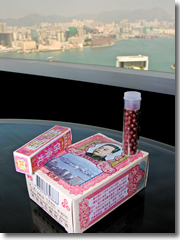
Don't be afriad to try local remedies. In Hong Kong, over the counter medications often take the form of a phial of tiny round pills, like buckshot, rather than a single capsule. This stuff still helped settle my companion's upset tummy. Travel—especially the high-stress, never-stop, whirlwind variety—puts a strain on your system, and exotic bugs just love a stained system. It’s so much easier to set up housekeeping in you that way.
But we're m mostly talking about colds or maybe the flu here.
Even in exotic destiantions, a few sensible precautions can help you avoid catching anything too exotic—though occasionally there may be a different flu strain going around that you might pick up more easily than a local would:
Can I drink the water?
Generally, you can drink the water in Europe (except on trains), North America (except Mexico), and Oceania (Australia and New Zealand). Anywhere else (or if you're hiking in the backwoods), stick to bottled water or treat the tap water with a sterlizing filter... 
La Turista: The food and upset tummies
Whatever they call it—Montezuma's Revenge, the Pharaoh's Curse, Delhi Belly—many people will have a bout with diarrhea on the road. Immodium stops the issue pretty fast, but Pepto-Bismol also settles the tummy itself and can actually help cure the cause (rather than just treat the symptom)...
Medications and prescriptions
Take enough of any prescription medication you’re on to last your trip plus one week (just in case). Bring along extra written prescriptions in each drug's generic, chemical name, not a brand name, so foreign druggists can fill it...
Use local pharmacies
In most countries, pharmacies are the first lines of local health care. Pharmacists are astoundingly helpful (they can often hand out what it takes a prescription to get Stateside)...
On hospitals
In most Western countries (except the U.S.), hospitals are marvels of socialized medicine. For minor complaints or ailments you can often get taken care of lickety-split with no time spent in the waiting room, no forms to fill out, and no insurance co-pay...
Avoid bug bites
Avoiding bug bites and wearing insect repellant aren't just a comfort issue, it's a health concern as mosquitoes and ticks can carry disease—most famously malaria, but also dengue fever, yellow fever, Japanese encephalitis, and other nasty things you don't want to catch...
Check required vaccines
Travel in the developed world requires no more shots than most Westerners get with basic health care. For trips to more exotic locales, it's best to get any recommended vaccines (usually Hepatitis A and B, Japanese encephalitis, typhoid, and/or cholera). Yellow fever vaccines are required for most travel to sub-Saharan Africa and tropical South America...
Pollution and contacts
Some cities’ high pollution levels can leave your throat a little raw and chest wheezy for a day or two, and can cause grit to get between contact lenses and eyeball and irritate you no end...
Section Index |
Related Partners
|
This article was by Reid Bramblett and last updated in August 2011.
All information was accurate at the time.
Copyright © 1998–2013 by Reid Bramblett. Author: Reid Bramblett.

 |

|
- Trip Planning
- Getting there
- Getting around
- Where to stay
- Hotels
- Alternative accommodations
- Agriturism / farm stays
- Apartments
- B&Bs
- Camping
- Castles
- Chains
- Convents
- Cottages/gîtes
- CouchSurfing
- Crash-ins
- Crewing a boat
- Dude ranches
- Sleep for free
- Historic inns
- Home swapping
- Hospitality exchange
- Hostels
- Hotels
- House sitting
- Monasteries
- Motels
- Mountain huts
- Overnight trains
- Rental rooms
- Residences
- RVing
- Schlaf im stroh
- Servas
- Sleeping in airports
- Universities
- Villa rentals
- WWOOFing
- Reid's recommended hotels
- Sleep for free
- What to see & do
- Planning your time
- Packing
- Paperwork & passports
- Getting info
- Communications
- Safety & crime
- Health & insurance
- Money & shopping
- Destinations
- Adventures
- Sponsor:
The Travel Store        |
Travel health insurance: Squaremouth.com, Insuremytrip.com, Medexassist.com, iamat.org, Medjetassist.com
Travel health gear: , REI.com, Magellans.com
Centers for Disease Control and Prevention: Cdc.gov
World Health Organization: Who.int
International Association for Medical Assistance to Travelers: Iamat.org
International Society for Travel Medicine: Istm.org