How to get money when traveling
Changing money in foreign countries—Exchanging dollars for euros, yen, pesos, or pounds
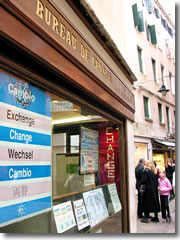 Exchange offices and booths abound—like this one in Venice—but you'll get a far better deal going to a bank.
• ATMs vs credit card
• Where to change money
• Commissions
• Exchange rates
• Currency convertersBefore you change your first dollar, know this:
You will get a far, far better exchange rate (roughly 9% better) paying by credit card than you ever will using an ATM to get cash.
(Let's not even talk about the crummy rates you get exchanging traveler's checks or using a commercial exchange office rather than a bank.)
A study in June, 2011, showed that the exchange rate you get by using a credit card was, on average, 8.9% better than that charged by U.S. banks to get cash out of an ATM (coupled, in some case, with fees).
That's like tearing up a $10 bill for every $111 withdrawn from a foreign ATM.
The actual bank-by-bank numbers ranged from 4% worse than credit cards (at Northern Bank) to 14.25% worse (way to top the charts, U.S. Bank!). The only thing worse than a bank was using the exchange service Travelex (where you take a 14.7% hit).
Still, not everywhere accepts credit card (and some places will give you a cash discount), so you do need to have some local cash on hand. Here's how to get it.
Where to change money while traveling
Always exchange money at a bank or, if you're a cardholder, an American Express office.
Businesses emblazoned with "Exchange! Cambio! Wechsel! Change!" are exchange booths, and all of them—from venerable Thomas Cooke offices all the way down to the shady guy named Raoul who hangs around the bus station—offer a worse rate and/or higher commission than banks and should only be used in emergencies.
(For more on rates—which is even more boring than the commissions stuff we're about to discuss—scroll to the bottom.)
Shopping for the Best Deal
Most banks display a chart of the current exchange rates they're offering, either in the street window (these days digital and constantly updated) or on a sheet of paper taped up at the international teller's window inside. Make sure you're looking at the rate the bank is buying, not selling, U.S. dollars (if there are two columns of numbers next to each currency, the "buy" column is the lower amount).
When comparing rates bank to bank, what you want is the bank whose chart shows the highest number in the "buying dollars" column. This will be the best rate. However, unless you’re using the ATM, you must also factor in the commission fee. Sometimes this is a flat fee equal to a couple of dollars; other times it's anywhere from 2% to 10% of however much you're exchanging.
Occasionally, a slightly less attractive exchange rate coupled with low or flat fee commission can cost you less in the long run than a great-looking rate that's hiding a whopping commission in the fine print. Of course that depends on how much you change. Yes, this is going to involve doing math on a foreign street corner in two currencies.
Always use a bank
On the rare occasion that someone approaches you on the street with a rate too good to be true, it is. That shyster's got black market currency, and if his bills aren't counterfeit, his sleight-of-hand method of counting them out certainly is. Also, you can get arrested.
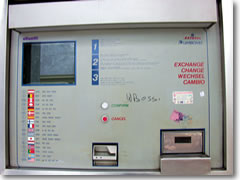 Avoid these bill-to-bill changers like the overpriced scams they are.
One other warning: Near some major attractions you may see multinational bill-to-bill changer machines that look like giant, slightly antiquated ATMs (you feed in dollar bills, it spits out the local currency).
The exchange rate on these (perfectly legal) swindle machines is...well, why don’t you just save us both the trouble and flush your cash down the toilet.
Demystifying Exchange Rates
Most newspapers print the official interbank rate in their business sections, but this only represents how much it costs banks to exchange money with each other—a rather better rate than you'll ever get.
Other papers, especially in travel sections, print the rate (2% to 4% below the interbank rate) you're likely to receive when exchanging money. When you exchange cash or a traveler's check, you generally get a rate that is 4% "worse" than the interbank rate. This is known as "+4%." It is also known as a "rip-off." If you exchange at any agency besides a bank or AMEX, you'll probably do even worse.
On top of this, any place will charge you a commission—either a flat fee (in which case changing a lot of money at once is cheaper) or a percentage of the total changed (in which case you're bleeding needlessly no matter how much or little you change).
Luckily, in the past few years computerized banking has ridden in on its white overcharger to save the day—or at least a few bucks for you. If you bypass the outdated and outmoded traveler's checks and steer clear of dealing with actual people, you can shave a few percentage points off. It’s called an ATM. If you take money out of a cash machine—either using your own bankcard linked to your personal checking account, or with a cash advance on a credit card—you will something closer to that favorable interbank rate.
Or at least, you should. In reality, you often don't. You get about 1% to 2% below that prime rate—still better than exchanging cash or traveler's checks, but not the best possible. Luckily, for now, most foreign banks do not charge that "ATM usage" fee that almost all U.S. banks have jumped on to nickel and dime us to death a bit more.
But if your home bank charges you for withdrawals from ATMs that are "out of network" (and yes, anywhere abroad is considered waaay out of network)—and its usually a steep $1.50 to $4.50 fee each time—you're still paying a commission of sorts.
I actually shopped around for a bank that doesn't do this, so they are out there. (Credit unions are also a good bet  .)
.)
Still, using an ATM linked to your checking account is for now the cheapest way to get money, and paying cash is the still the second cheapest way to travel (after using credit cards).
Checking exchange rates online with currency converters
Oanda (www.oanda.com) - I like this one because it lets you check several different versions of the going rate. The "+4%, cash rate" represents the best you'll find if you exchange travelers checks or cash at a bank. The "+2%" rate is usually what you'll get if you use a credit card to make a charge or get a cash advance.
Universal Currency Converter (www.xe.net) - An alternative to Oanda. Use whichever interface you prefer.
Related articles |
|
This article was by Reid Bramblett and last updated in November 2011.
All information was accurate at the time.
Copyright © 1998–2013 by Reid Bramblett. Author: Reid Bramblett.

 |
- Trip Planning
- Getting there
- Getting around
- Where to stay
- Hotels
- Alternative accommodations
- Agriturism / farm stays
- Apartments
- B&Bs
- Camping
- Castles
- Chains
- Convents
- Cottages/gîtes
- CouchSurfing
- Crash-ins
- Crewing a boat
- Dude ranches
- Sleep for free
- Historic inns
- Home swapping
- Hospitality exchange
- Hostels
- Hotels
- House sitting
- Monasteries
- Motels
- Mountain huts
- Overnight trains
- Rental rooms
- Residences
- RVing
- Schlaf im stroh
- Servas
- Sleeping in airports
- Universities
- Villa rentals
- WWOOFing
- Reid's recommended hotels
- Sleep for free
- What to see & do
- Planning your time
- Packing
- Paperwork & passports
- Getting info
- Communications
- Safety & crime
- Health & insurance
- Money & shopping
- Destinations
- Adventures
- Sponsor:
The Travel Store        |
ATM locators: Mastercard.com, Visa.via.infonow.net
Credit cards with low foreign transaction fees: Capitalone.com, Hsbc.com, Providian.com
Financial institutions and credit cards with no or low foreign transaction fees: Credit unions & Local banks (Creditunion.coop, Moveyourmoneyproject.org, Findabetterbank.com, Ncua.gov, Credituniondb.com); Online-only banks (Usaa.com , Ally.com, Schwab.com, Ingdirect.com), major bank with 0% fee (Capitalone.com); major banks with 1% fee (Hsbc.com, Providian.com
Good intel on cards & travel money issues: FlyerGuide.com, Bankrate.com, Cardhub.com, Creditcards.com
Traveler's Checks: Aaa.com, Americanexpress.com, Thomascook.com
Wiring money: Westernunion.com, Moneygram.com, Xoom.com
U.S. Customs: cbp.gov
Duty Free: Thedutyfreepriceguide.com
VAT and tax refunds: global-blue.com, Premiertaxfree.com