U.S. Customs regulations
What you can and cannot bring home with you from your travels
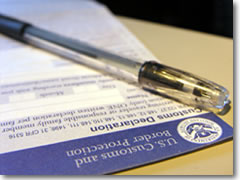
The U.S. Customs form, which for some reason the flight attendants always hand out right after you take off, rather than waiting until, say, half an hour before you land.
• Why customs limits?
• Getting through customs
• Getting around the limits (legally)
• Items you cannot importTechnically, there are no limits on how much loot you can bring back into the United States from a trip abroad, but the customs authority does put limits on how much you can bring back for free.
Full details will follow in a sec, but the two important figures are: you can bring home $800-worth of goods per person, including a measly 1 (one) bottle of wine or booze. (You can bring back more, but you'll have to pay a tax.)
Why are there cutoms regulations?
There are two main reasons: to regualte imports for taxation purpsoes, and to keep out illegal or dangerous items (which can range from the obviously illegal to the seemingly innocuous, like potentially invasive plant, animal, or insect species).
iIt's the first restriction that gives us the $800 limit, which is mainly for taxation purposes: to separate tourists with souvenirs from importers with profit motives.
What and how much you can bring into the United States is controlled by the U.S. Customs office (www.cbp.gov), which basically views you as a small-time importer/exporter. Importers have to pay a governmental duty (tax) on any foreign-made item they bring into the country.
However, the customs office realizes that the majority of travelers are merely bringing home items as souvenirs or gifts or for their personal use, and magnanimously allow you to bring in up to $800 worth of souvenirs and a few drops of that Italian wine for free.
Note that this has absolutely nothing to do with the Duty Free Shop at the airport—though people constantly confuse the two. The "duty," or tax, you are avoiding by shopping at these stores is the local tax on the item (like state sales tax in the United States), not any import duty that may be assessed by the U.S. customs office. All of this is explained on the Duty Free page.
It also has nothing to do with VAT tax refunds or Tax-Free Shopping . For the scoop on VAT and tax refunds, click here.
Well, I Do Declare! Getting Through Customs
In a development so shocking I checked it twice to be sure there wasn't an error, the federal government has actually made it easier to bring your stuff home.
In 2003, they doubled the cash value on goods US citizens allowed to take home without paying tax from $400 to $800 per person—so long as you've been out of the country for at least 48 hours and haven't used the exemption in the's past 30 days (rules designed to foil any small import/export sideline an airline crew member might try to get going).
The bad news is that they haven't changed the draconian limits on, shall we say, comestibles of vice. I've got no problem with the rules limiting you to 200 cigarettes and 100 cigars, but I find it patently ridiculous that you are only allowed to bring home a single liter of alcoholic beverage.
Do they honestly think that, should you bring home one bottle of Chianti from Tuscany as a present for your folks, and a bottle of Barolo from Piemonte for yourself, plus a bottle of grappa or limoncello you know you'll never find at home, you're attempting to hide an import business? Really, it's quite silly. And I believe that most customs officials quietly agree. I've brazenly written down all two (or three, or four) bottles of wine that I'm taking home right there on the form, and have yet to have a customs officer take issue with it.
Of course, you are allowed to take far more than one bottle home—of every more than $800 worth of stuff. They just reserve the right to tax you on it (see below).
How can I get around the $800 limit?
Antiques over 100 years old and works of art are exempt from the $800 limit.
So is anything you mail home from abroad.
This is the Great Loophole. You can mail yourself up to $200 worth of good per day, so long as the package is marked "For Personal Use."
You can also mail up to $100 worth of stuff per day to friends and family (or technically, I guess, even strangers) so long as the packages are marked "Unsolicited Gift." Actually including a gift for your buddies (rather than just sending them your own booty to hold onto for you) would be a nice touch.
Either way, you must list the contents of any package on the outside wrapping, and you cannot mail alcohol, perfume (because it has alcohol in it), or tobacco products worth more than $5.
What happens if I go over the $800 limit?
Sure, it can happen. And when it does, the government wants to take a bite out of the value of whatever you're bringing home. That bite starts at 3% of the total value of your goods for the first $1,000 above and beyond the $800 limit. After that, you're looking at an item-by-item duty.
Is there anything I cannot bring home? What about meats and cheese?
What do Dutch elm disease, hoof-in-mouth, and the Mediterranean fruit fly epidemic all have in common? They are all plagues that were brought into the United States by unscreened travelers—and have caused untold ecological and economic damage and widespread regional extinctions.
Go ahead: Ask any southerner if importing Asian kudzu was a good idea, or any farmer or forester if what we really need more of is exotic beetle species that can ravage crops or decimate entire species (and can easily be hiding in the plant cutting or piece of fruit smuggled into your carry-on bag).
That's why there are some things you absolutely cannot bring into the U.S.
The U.S. Customs service (www.cbp.gov) lists all the details; here's the brief version.
You may not bring into the United States:
- plants
- fruits
- vegetables
- meat
- most food items
- seeds (technically, you can import seeds for vegetables or flowers—not trees—if you can get a phytosanitary certificate of inspection from the country of origin and also declare them to customs upon arrival; more: www.aphis.usda.gov)
Yes, this means the salami that the shopkeeper in Siena swears up and down is fine for you to bring home will not be let in if they discover it.
There are, however, some exceptions to the general food/plant rules.
You may bring home:
- baked goods
- cheeses (so long as it's not the soft, spreadable kind; if it's runnier than a Brie, no dice)
- tinned pâtés
- candy
- roasted coffee beans and dried teas
- mushrooms
- packaged fish (so smoked salmon from Norway is A-OK)
Why it is stupid to try and sneak something through customs
On a more personal note: do not try to sneak anything on the no-no list home with you. Our ecosystem has enough problems without you trashing it just because you wanted to smuggle in a salami or a tiny olive tree.
Just about anything on the restricted list is pretty widely available back in the U.S., so if you really want a fig tree, go out and buy a fig tree from a nursery near your house. If you want some Italian prosciutto, visit your local supermarket and pay extra for "imported."
Smuggling something from these lists in isn't cute, funny, or a boastable instance of putting one past the man. It's downright dangerous.
There's a reason they won't let you take this stuff home—same reason they make you wash your shoes in the airport if you've been on a farm abroad. That is to stop the spread of mad cow disease. Trust me: you don't want that here. I had a friend (in Italy) who died from spongiform encephalopathy (a.k.a. mad cow). It isn't pretty.
Related articles |
|
This article was by Reid Bramblett and last updated in November 2011.
All information was accurate at the time.
Copyright © 1998–2013 by Reid Bramblett. Author: Reid Bramblett.

 |
- Trip Planning
- Getting there
- Getting around
- Where to stay
- Hotels
- Alternative accommodations
- Agriturism / farm stays
- Apartments
- B&Bs
- Camping
- Castles
- Chains
- Convents
- Cottages/gîtes
- CouchSurfing
- Crash-ins
- Crewing a boat
- Dude ranches
- Sleep for free
- Historic inns
- Home swapping
- Hospitality exchange
- Hostels
- Hotels
- House sitting
- Monasteries
- Motels
- Mountain huts
- Overnight trains
- Rental rooms
- Residences
- RVing
- Schlaf im stroh
- Servas
- Sleeping in airports
- Universities
- Villa rentals
- WWOOFing
- Reid's recommended hotels
- Sleep for free
- What to see & do
- Planning your time
- Packing
- Paperwork & passports
- Getting info
- Communications
- Safety & crime
- Health & insurance
- Money & shopping
- Destinations
- Adventures
- Sponsor:
The Travel Store        |
Duty Free: Thedutyfreepriceguide.com
VAT and tax refunds: global-blue.com, Premiertaxfree.com
Currency converters: Oanda.com, Xe.net
ATM locators: Mastercard.com, Visa.via.infonow.net
Credit cards with low foreign transaction fees: Capitalone.com, Hsbc.com, Providian.com
Financial institutions and credit cards with no or low foreign transaction fees: Credit unions & Local banks (Creditunion.coop, Moveyourmoneyproject.org, Findabetterbank.com, Ncua.gov, Credituniondb.com); Online-only banks (Usaa.com , Ally.com, Schwab.com, Ingdirect.com), major bank with 0% fee (Capitalone.com); major banks with 1% fee (Hsbc.com, Providian.com
Good intel on cards & travel money issues: FlyerGuide.com, Bankrate.com, Cardhub.com, Creditcards.com
Traveler's Checks: Aaa.com, Americanexpress.com, Thomascook.com
Wiring money: Westernunion.com, Moneygram.com, Xoom.com