A rail station is more than the sum of its trains
Like the trains themselves, European train stations tend to be clean and user-friendly—with tourist info, hotel booking service, lockers or offices where you can store your luggage, and snack bars better than you'd expect (in case you forget to pick up train picnic supplies in town).
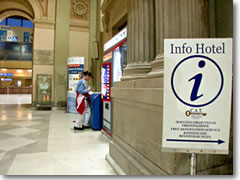 European rail stations often have info offices for train intel, tourist info, and hotel bookings.
European rail stations are much more than just place to hop a train.
They have ATMs, hotel booking services, photo booths, baggage storage lockers, cafes, tourist info offices, newsstands (which, along with newspapers, is also the best place to find city maps, bus/metro tickets, postal stamps, and a small selection of books in English), restrooms, and in bigger cities, often plenty of shops and 24-hour pharmacies.
If you know how to use the train station for all it's worth, you can spend 20 minutes there when you first arrive in a city and come out of it well-oriented and fully armed for your visit.
Arriving in Town
- Stop by the station's ATM or bank for a bit of local cash (not too much; a downtown branch might have better exchange rates).
- Hit the tourist board kiosk or desk and milk it for all the free info, maps, and brochures you can get.
- Visit a newsstand to see whether the city maps for sale are better than the free one from the tourist office (usually the answer is yes, and the investment is worth it). Pick up a phone card (if you'll be in the country long enough to use it), grab a few city bus or metro tickets to get you started, and buy the local English-language information/events magazine.
- Now that you have some pocket change, you may want to dump your main bag in a locker or left luggage office for $2 to $10 a day and keep just your daypack. If you're just dropping by town for a half-day visit, the bags will stay there. If you're spending the night, go hotel hunting without your pack, and you'll have more stamina and bargaining leverage to get the best deal.
- Head to the phones and call around for a hotel, or use the station's hotel booking service.
- Before you exit the station upon arrival, check out your train options for leaving town a few days down the line (as well as for any day trips you plan to make). That way, you can swing by a day or two before you leave to buy your tickets and reserve seats or couchettes rather than wait until the last minute when the lengthy ticket lines may thwart your precision-timed plans.
Getting out of Dodge
The rail information desk —not to be confused with the city tourist board's desk , because the two won't answer each other's questions—usually has a long line, and the staff was born harried. Use the do-it-yourself information sources as much as possible.
Modern stations in big cities often have computerized rail information kiosks and automatic ticketing machines , but both can be on the fritz (or feature lines as long as those queuing to talk to a flesh-and-blood ticket agent).
In smaller towns, the tiny station bar may double as the ticket office, but most stations have banks of ticket windows . Try to figure out which window you need before getting in the invariably long lines. The bulk of windows will be for purchasing regular tickets; a few windows will be for people who just need reservations (if, for example, you have a Eurail pass but plan to take a reservations-required train or want to reserve a sleeping couchette). A few windows may be for international or special high-speed trains only.
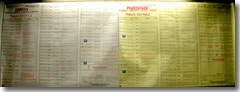 I know it's hard to see, but those are two train schedule posters. All of Europe uses this system; on the left are arrivals, on a white poster; on the right are departures on a yellow poster. For a detailed close-up, go to the European Rail System page.
Almost all stations (except, annoyingly, some in Paris) have schedule posters that list the full timetables and regular track numbers for all trains that pass through. Usually, but not always, arrivals are on a white poster and departures are on a yellow one, as in the picture to the right. (There's a close-up shot of the "departures" half, along with detailed explanation of how to read the poster, on the European Rail System page.)
These posters show how many trains a day go where you want to go, when precisely they leave, whether you need a reservation (marked by a prominent "R" in the column detailing the train's car options—1-2 class or just 2 class, sleepers available, bikes allowed, etc.).
The poster also shows you what the ultimate destination on that train will be. For example, you may want to get from Paris to Pisa, but the train will be marked to Rome; Pisa is merely a stop along the way (and these posters do list all the major stops along the way, including what time the train arrives at each).
>> More on train stations (finding your train and the best seat)...


 ShareThis
Related Articles |
Outside Resources |
This article was last updated in October 2006. All information was accurate at the time.
Copyright © 1998–2010 by Reid Bramblett. Author: Reid Bramblett.