America's byways
A guide to the road less traveled

Mississippi's Route 4, cutting east through the kudzu-blanketed woods of central Mississippi’s Hill Country.
One of my favorite travel books is William Least Heat Moon's Blue Highways, a journey through the heart and soul of America in a rickety old van.
The title comes from Least Heat Moon's map, which used a blue line to indicate any road that was not an interstate or major highway, and the author's vow to stick only to those smaller byways in his cross-country trek.
The result was a portrait of the sort of small town USA many jaded city and suburb folk like myself figure must have disappeared by the 1960s. It hasn't, and after a bit of exploring you, too, will find that the road map to America's doorstep is drawn using country roads, rural routes, and scenic byways.
The real America resides just down a two-lane blacktop road that winds its way through farmland and passes through the courthouse squares of countless small towns. Those four-lane highways that shoot ruler-straight across a map to link major cities pass little besides endless carbon-copy exits barnacled with identical businesses and services.
What's more, the road less traveled can save you money in many small but important ways while giving you a more genuine and memorable experience while doing it--a diner will beat out the golden arches for atmosphere any day, as will a local motel over a cookie-cutter chain.
Off the beaten path and into the savings
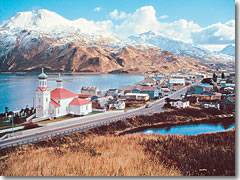
The red and green roof of a Russian-Orthodox-style church brings a spot of color to the mountainous winter landscape on Alaska's Marine Highway.
Not only do scenic byways give you the chance to see some of the prettiest corners our country has to offer, but they can also save you money while enriching your experience—and who doesn't love that?
Scenic byways, see, get you off that interstate highway treadmill of chain fast food joints and identikit exit conglomerations of mini malls and mega gas stations that have collectively conditioned us to passively pay $1.59 for a soda and $3.50 for a cinnamon bun, and to think that $89 is a great rate for a Red Roof Inn.
The back roads of America, though, are where chrome-plated diners with worn booths still charge just $3.95 for a steak, $0.35 for coffee, and $0.95 for a slice of that strawberry-rhubarb pie sitting under the plastic dome on the counter lined with locals perched atop little round stools.
This is where locally-owned gas stations still charge $0.50 for a can of Coke (the gas, of course, is pricey everywhere), and mom-and-pop motels—small and achingly plain, but usually clean and tidy—advertise rates of $29.95 above a neon "Vacancy" sign where the "No" bit is hardly ever lit up.
The government's stamp of approval
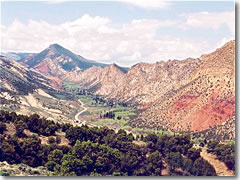
A breathtaking view is captured looking west from a pullout along the Flaming Gorge - Uintas Scenic Byway in Utah.
Since 1992, the U.S. Secretary of Transportation has so-far declared 151 roads in 46 states to be official America's Byways (www.byways.org)—120 of them "Scenic Byways", another 31 titled "All-American Roads." Twenty of them are multi-state byways (think: Route 66).
These are all roadways that feature "outstanding archaeological, cultural, historic, natural, recreational, and scenic value."
These officially designated America's Byways comprise more than 25,000 memorable miles of road, ranging from the 1,707-mile Great River Road that parallels the mighty Mississippi through Illinois, Iowa, Wisconsin, and Minnesota to the 4.5-mile Las Vegas Strip.
What can you see on a scenic byway? You can trace Billy the Kids' history in New Mexico, cruise the Big Sur section of California's Pacific Coast Highway, tear through the desert of Death Valley, paddle over a 3,000-year-old underwater forest in an Oregon lake, and celebrate the Mike the Headless Chicken Days on May 16–17 in Colorado (I'm not making that up: www.miketheheadlesschicken.org).
And, it almost goes without saying, you can get your kicks on Route 66.
Indeed, in between the Tamiami Trail of Florida and the Seward Highway of Alaska, you can travel scenic byways to pay homage to such hallowed icons of Americana as the world's largest ketchup bottle (www.catsupbottle.com), George Washington's bathtub in West Virginia, and the seven-foot fiberglass statue of Superman guarding the Smallville-sized town of Metropolis, Ohio.
Free maps! (a.k.a.: Planning a trip made easy)
 National Geographic Guide to Scenic Highways and Byways: The 275 Best Drives in the U.S. - This is a great book, featuring unique driving tours through virtually every kind of landscape—spectacular coastlines, mountains, lakes, small towns, ranch and farmlands, islands, bays, and river valleys—in all 50 states. Some of the routes are famous, such as Virginia's Skyline Drive and Blue Ridge Parkway, the Natchez Trace, and picturesque sections of the Great River Road. But there are lesser-known drives here as well.
  The America's Byways organization lives at www.byways.org, where you can find out much more about the program and its byways. It will also send you free maps—though note that you're supposed to allow two to three weeks for delivery, and they don't have nearly the sorts of depths of travel information you might hope for.
You can get even better maps (though not Byways-specific) free from your local AAA (www.aaa.com), or go all-in and buy some of my favorite maps of all time, the remarkably detailed DeLorme Atlas and Gazeteer series.
Still, the offical Byways maps are a starting point, and teh best place to start is back at the official scenic byways Web site. In the "Explore Byways" section, you can view information route by route and peruse brief synopses of the various sights, attractions, and towns along the route, (those could be longer, but at least they're linked to local Web sites where you can get more info).
More importantly there are long sections devoted to how each Byway qualifies in terms of those six core categories; archaeological, cultural, historic, natural, recreational, and scenic--and that's the kind of esoteric background rarely gathered together in one spot for you to explore.
The site does not, unfortunately, have links to lodging or dining options along the way—which is why there's a whole list of good guidebooks for road trips on this site—including one produced by the folks at National Geographic designed specifically for these scenic America's Byways.
See you on the road!
Related Articles |
|
This article was by Reid Bramblett and last updated in January 2012.
All information was accurate at the time.
Copyright © 1998–2013 by Reid Bramblett. Author: Reid Bramblett.

 |
- Trip Planning
- Getting there
- Getting around
- Where to stay
- Hotels
- Alternative accommodations
- Agriturism / farm stays
- Apartments
- B&Bs
- Camping
- Castles
- Chains
- Convents
- Cottages/gîtes
- CouchSurfing
- Crash-ins
- Crewing a boat
- Dude ranches
- Sleep for free
- Historic inns
- Home swapping
- Hospitality exchange
- Hostels
- Hotels
- House sitting
- Monasteries
- Motels
- Mountain huts
- Overnight trains
- Rental rooms
- Residences
- RVing
- Schlaf im stroh
- Servas
- Sleeping in airports
- Universities
- Villa rentals
- WWOOFing
- Reid's recommended hotels
- Sleep for free
- What to see & do
- Planning your time
- Packing
- Paperwork & passports
- Getting info
- Communications
- Safety & crime
- Health & insurance
- Money & shopping
- Destinations
- Adventures
- Sponsor:
The Travel Store        |