Custer State Park : The Great American Safari
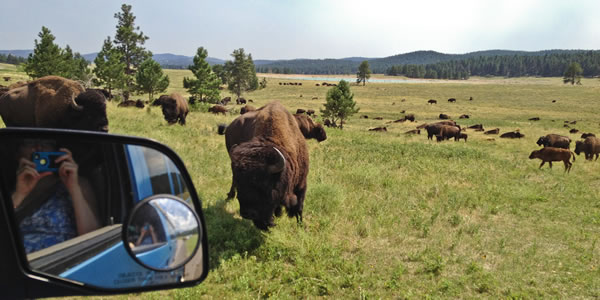
Custer State Park, in the Black Hills of South Dakota, is one of the best places in America for spotting lots of photo-ready animals: buffalo, antelope, big horn sheep, prairie dogs, deer... the list goes on
This is my favorite state park in America. No contest.
When the anonymous cowboy poet of Home on the Range wrote "Oh, give me a home where the buffalo roam / Where the deer and the antelope play," he must have been thinking about South Dakota's Custer State Park (605-255-4515, gfp.sd.gov/state-parks/directory/custer).
Custer State Park—73,000 acres of granite peaks, mountain meadows, sparkling lakes, and ponderosa pine–shrouded foothills—is tucked into the Black Hills of southwest South Dakota, just 20 miles south of Mt. Rushmore (and 28 miles from Rapid City) and 88 miles west of the weirdly eroded landscape of the Badlands.
Custer may only rate a "state park" ranking, but for my money it blows away half the national parks in the system.
It's no great shakes in the hiking department (about a dozen trails ranging from one to 22 miles), but has spectacular scenery, drop-dead gorgeous lakes, thrilling drives, and hands-down some of the best wildlife spotting in the entire country.
In fact, a drive through the park is like a big game safari, American-style.
Antelope and coyote and buffalo, oh my!
I've been to more than 100 national parks, monuments, forests, etc., and I'll tell you right now: if you want to see the highest concentration and variety of impressive wild animals in the shortest period of time, take a drive through Custer—especially the 18-mile Wildlife Loop Road.
Every time you come around a bend, there seems to be a small herd of tawny, white-striped pronghorn (the American "antelope"—though they are not, technically, antelopes) grazing on the shoulder, a massive buffalo bull lazing by a creek, small stands of whitetail or mule deer nibbling grass in the shade, wooly white mountain goats scampering up a steep hillside, wild mules looking for handouts, or a lone coyote loping through the grass near the entrance to Wind Cave National Park.
Once, I jumped out of my car to snap a picture of Sylvan Lake and nearly stepped on a five-foot snake.
When I stopped to photograph some Rocky Mountain bighorn sheep (transplanted cousins to the now-extinct Audubon sheep that once roamed the park) picking their way up a steep hill in the sun-dappled shadow of pine and oak, I found myself standing in the middle of a prairie dog town. Its residents yipped and scolded me as they high-tailed it into their burrows to pop up and down, whack-a-mole style (which I thought was cute, until I remembered the little guys can carry the bubonic plague).
I saw all of those on a single drive through the park. (And it wasn't a fluke; I've been galf a dozen tiems, and see most animals on just about every summetimes visit). Just about the only big animal I didn't get a glimpse of in Custer was one of their 1,000 elk.
And we haven't even mentioned the 180 species of birds. (If you stay at Custer Park Game Lodge, you're likely to get a wild turkey wake-up call, which sounds like someone strangling seagulls.)
But the animal you can see in Custer like nowhere else on Earth is the American bison .
Custer State Park is home to one of the largest publicly owned buffalo herds in the world. Somewhere between 1,200 and 1,500 buffalo roam free in the park, and tend to use the park's roads to migrate, making for possibly the most photographic traffic jams in America.
Come fall, cowboys gather to round up the herd in one of the best glimpses into an authentic Wild West tradition that continues to this day (trust me; I got to help round them up in 2006).
The Needles: Scaling pinnacles of rock by car and by rope
Beyond the wildlife, what draws most folks to Custer is the vehicular thrill ride of Needles Highway, a 14-mile rolling, curving ribbon of road hairpin-turning and roller-coastering 6,400 vertical feet up past cathedral spires of rock and threading through tight slots and narrow tunnels bored through the mountainsides.
To its north, beyond Cathedral Spires and Little Devil's Tower, looms Harney Peak —at 7,242 feet, the highest mountain east of the Rockies.
Driving past the most photographed of the rock pinnacles, the Needles Eye, I saw two old-timers rappelling past the 60-foot high/three-foot wide slit through the rock that gave it its name. I congratulated the intrepid climbers when they reached the bottom, and politely tried to find out how old they were. George proudly admitted to being 71; Pete wouldn't say, just that he was young enough to still be able to climb the Eye.
Age aside, I'm nowhere near talented enough to tackle something like the pinnacles, so when I wanted to strap on a harness and scramble up some rocks, I made my way to the end of the Needles Highway at scenic Sylvan Lake to hook up with Daryl Stisser.
Daryl is a guide with Sylvan Rocks, which runs climbs of the Needles, Mt. Rushmore, and Devils Tower, just over the Wyoming border (www.sylvanrocks.com; 3-hour "Discover Climbing" course $65, 6-hour basics courses from $150 per person).
The water reflected a puffy-clouded cobalt sky and the low cliff of rounded and time-smoothed boulders that formed the boundary of the far side of the lake. As we crunched along the path around the picture-perfect lake, I asked Daryl about the odd platform in the middle of the lake.
"Oh, that's to aerate the water." I looked at him, and he explained that the lake is so overstocked with fish for sportsmen that they have to artificially oxygenate the waters to keep the fish alive.
I dunno; doesn't seem very sporting to me.
Where to stay in Custer
Talk about wildlife; When I stayed at Custer's Stockade South campground in the summer of 2006 (one of seven campgrounds in the park ), in order to get from my tent to the restrooms I had to navigate a Beatrix Potter tableau of nibbling deer, twittering birds, and hopping bunny rabbits. Custer campgrounds cost $13–$15 per night (except French Creek Natural Area, a bargain $2 per person per night). You can reserve campgrounds at 800-710-2267 or www.campSD.com.
On another visit, in the dying days of September, I left the tent at home to shack up in relative style at the Custer Park Game Lodge (605-255-4541 or 800-658-3530; www.custerresorts.com; $95–$160), a log cabin mini-mansion atop a grassy rise at a curve in the park's main road.
The lodge served Calvin Coolidge as a summer White House, and now rents rooms ($95–$135), wings of nice motel units ($125–$185), and a scattering of cabins (nos. 4–9 are set back from the road in an oak grove along a creek; avoid nos. 1–3, right on the road; $110–$125 regular cabin, $155–185 housekeeping cabin).
The dining room ain't bad (picture a wood-paneled 1950s den, only filled to the rafters with stuffed pheasants and antler trophies), but for a quickie meal I recommend a buffalo burger and Killian's at the hotel bar.
There are three other lodges in the park. The Blue Bell Lodge (605-255-4531 or 800-658-3530, www.custerresorts.com; $175–$195 cabin, $125–$195 housekeeping cabin) is a log cabin with a dude ranch theme arranged around chuckwagon cookouts and trail rides.
The other two overlook lovely lakes: the 1937 Sylvan Lake Resort (605-574-2561 or 800-658-3530; www.custerresorts.com; $120–$185 room, $140–$185 cabin, $125–$210 housekeeping cabin), and Legion Lake Resort (605-255-4521 or 800-658-3530; www.custerresorts.com; $110 cabin, $145–$175 housekeeping cabin), great for trout fishing.
While you are there, check out what is playing at the excellent Black Hills Playhouse (blackhillsplayhouse.weebly.com). I took my four-year-old to a musical there one summer (the Drowsy Chaperone) and it was near Broadway quality (and this is from someone who lived in New York City for nearly a decade, alright?).
You can reserve any of the lodges at 800-658-3530, www.custerresorts.com.
Related Articles |
|
This article was by Reid Bramblett and last updated in June 2012.
All information was accurate at the time.
Copyright © 1998–2013 by Reid Bramblett. Author: Reid Bramblett.

 |
- Trip Planning
- Getting there
- Getting around
- Where to stay
- Hotels
- Alternative accommodations
- Agriturism / farm stays
- Apartments
- B&Bs
- Camping
- Castles
- Chains
- Convents
- Cottages/gîtes
- CouchSurfing
- Crash-ins
- Crewing a boat
- Dude ranches
- Sleep for free
- Historic inns
- Home swapping
- Hospitality exchange
- Hostels
- Hotels
- House sitting
- Monasteries
- Motels
- Mountain huts
- Overnight trains
- Rental rooms
- Residences
- RVing
- Schlaf im stroh
- Servas
- Sleeping in airports
- Universities
- Villa rentals
- WWOOFing
- Reid's recommended hotels
- Sleep for free
- What to see & do
- Planning your time
- Packing
- Paperwork & passports
- Getting info
- Communications
- Safety & crime
- Health & insurance
- Money & shopping
- Destinations
- Adventures
- Sponsor:
The Travel Store        |
Tourism information: Travelsd.com